
On August 5, 2024, after Sheikh Hasina's flight to India and the subsequent dissolution of the then parliament by the President the next day, the question of forming a government became significant. Finally, on August 8, in accordance with constitutional continuity and Article 106 of the constitution, an interim government was formed on the advice of the Chief Justice. At least two top leaders (later three) from the July mass uprising became part of this government. As a result, everyone, regardless of party affiliation, accepted this government.
However, the debate continues as to whether the mass uprising of July-August was a popular revolution or a coup. Those who wanted to see it as a popular revolution began to raise demands for a revolutionary declaration and a revolutionary government immediately after Hasina's flight. However, as it ultimately did not materialize, and a government was formed while maintaining constitutional continuity, many of them became disheartened. The leading thinker and intellectual of this genre, Farhad Mazhar, identified the event of forming an interim government on August 8 as a 'constitutional counter-revolution.' According to his analysis, a popular revolution had taken place against the existing constitutional system in July; subsequently, in the name of maintaining constitutional continuity, it was absorbed within the old system of rules. He refers to this process as a 'constitutional counter-revolution.'
However, even after the formation of the government on August 8, the desire to view the political reality of July-August and the newly formed government as a 'revolutionary reality' and a 'revolutionary government' persisted in various ways within the political and intellectual spheres. In this context, two and a half months after the formation of the government, the platform leading the July mass uprising, the Anti-Discrimination Student Movement, raised the demands of the 'July Declaration' and the 'Second Republic.' On October 22, 2024, they announced five demands from the Shahid Minar. The demands were:
1. The existing constitution must be immediately abolished and a new constitution must be written in the context of the people's uprising of '24.
2. The Chhatra League must be permanently banned from Bangladesh as a terrorist organization.
3. President Shahabuddin must be forced to resign within this week
4. The 'Proclamation of the Republic' must be declared in light of the July Revolution
- To find discussions on the nature of the July mass uprising, see: Ar Razi, ‘Revolution-Mass Uprising-People's Uprising’; Jobair Al Mahmud, ‘Is the July Mass Uprising a Failed Revolution, or a New Form of Post-Modern Democratic Revolution?’; Mosahida Sultana, ‘July Movement: Color Revolution, or Mass Uprising?’; Selim Reza Newton, ‘People's Revolution-Flow: Draft of the Ongoing Manifesto’; (ed.) Sahul Ahmed, Essays on the July Mass Uprising, Bangla Academy, 2025
- Farhad Majhar has been promoting this idea through various interviews, speeches, and writings since the twenty-fourth of August. The most coherent expression of his position can be found here: Farhad Majhar, ‘July Mass Uprising and Constitutional Counter-Revolution’, Chinta, November 30, 2025
5. The 10th, 11th, and 12th national parliamentary elections of 2014, 2018, and 2024 must be declared illegal. The assets of those elected in these three elections must be confiscated, and legal measures should be taken to ensure that they can never participate in elections in Bangladesh again.
After the mass uprising led by prominent leaders and activists in July, the platform National Citizens' Committee, formed on September 8, 2024 (from which the National Citizens' Party or NCP was later established), expressed immediate solidarity with the demands. Subsequently, leaders of the anti-discrimination student movement and the National Citizens' Committee held meetings with various political parties and alliances to create a national consensus regarding these demands. Political parties and alliances aligned with the BNP expressed doubts about why such demands emerged in the field two and a half months after Hasina's fall. They also expressed concerns that the removal of the president could create a constitutional vacuum. On the other hand, while Jamaat-e-Islami agreed with these demands in principle, they suggested that the course of action should be determined based on political consensus. Several other parties, including the Islamic Movement, AB Party, and Gana Adhikar Parishad, agreed with the students' demands; however, they expressed various opinions regarding the methods of implementing these demands.
 Photo: Presentation of the 5-point demands by the anti-discrimination student movement and the leaders of the National Citizens Committee
- Bonik Barta, 'Five Demands Including the Abolition of the Constitution by the Anti-Discrimination Student Movement', October 22, 2024
In summary, there was no political consensus at that time regarding the initiative taken by the student leaders to "transform the unfinished revolution into a true revolution." The government also did not take any further initiatives in this regard.
Subsequently, on December 31, 2024, the leaders of the anti-discrimination student movement and the National Citizens Committee announced the burial of the '72 Mujibist Constitution' by issuing the 'July Declaration' at the Shaheed Minar. This caused a stir in political circles and within the government. The government responded quite sternly regarding this matter.
- On December 28, 2024, after the evening, two similar posts were made consecutively on the verified Facebook page of the Anti-Discrimination Student Movement and the National Citizens Committee. The first post read, "Are the revolutionaries ready for December 31, 2024?" The next post was in English, stating, "Proclamation of July Revolution." Around the same time, Asif Mahmud, an advisor to the interim government, made two consecutive posts in English on his verified Facebook account. The first one said, "Comrades, now or never"; the second one stated, "Proclamation of July Revolution." Later, the convener of the National Citizens Committee, Nasiruddin Patwari, also made two posts in English on Facebook. The first one read, "All eyes on Shaheed Minar, December 31, time: 3 PM"; the second one said, "Proclamation of July Revolution, now or never." The organization's general secretary, Akhtar Hossain, wrote on Facebook, "It will happen this year, December 31, Insha'Allah!" The main organizer, Sarjis Alam, wrote, "December 31! Shaheed Minar, 3 PM; now is the time, for Bangladesh." The convener of the Anti-Discrimination Student Movement, Hasnat Abdullah, also made two posts regarding this on his verified Facebook account. The first one said, "Comrades, December 31! Now or never." The second post read, "Proclamation of July Revolution, December 31, Shaheed Minar, 3 PM." The organization's general secretary, Arif Sohel, wrote, "July will come to be immortalized in history, December 31, 2024." (Prothom Alo, "The 'Declaration of July Revolution' will be given on December 31," December 28, 2024)
- On December 29, Jugantor claimed that a copy of the draft declaration has reached them. It states that: since the people of Bangladesh fought for liberation from colonial rule in 1947, since Pakistan has treated Bangladesh discriminatorily in 1971, since the 1972 constitution has failed to realize the hopes and aspirations of our nation, and since martial law and constitutional amendments have gradually weakened the state. Through this rise and fall, the democratic institutions of Bangladesh have been destroyed and have failed to establish good governance. Since the struggle for Bangladesh's independence has been used as a weapon to establish fascist rule; the Pilkhana and Shapla Square massacres, judicial killings, and the rights of minorities have been manipulated; the student populace has risen against this discrimination; they have been denigrated as 'descendants of Razakars,' undermining their identity and dignity; law enforcement agencies have taken reckless roles in prolonging fascist rule; students had presented a 9-point demand, and attempts were made to silence the voices of the student populace by shutting down the internet and imposing curfews; the student populace had called for a non-cooperation movement; an unimaginable unity has been formed against fascism across all classes, professions, religions, ethnicities, and cultural groups, both right and left, thus the student populace has gained widespread public support and sacrificed thousands of lives. Alongside this, even today, hundreds of students and citizens are writhing in the agony of death, which is why we declare ourselves as an independent sovereign people. In this context... we demand the dissolution of Parliament. We want to prevent officials appointed during the Hasina government from performing state duties. We want an interim government under the leadership of Dr. Yunus. We call for the immediate release of Begum Khaleda Zia to prevent a recurrence of military rule and the events of 1/11. We demand the reform or abolition of the 1972 constitution. We want reforms in all institutions. We seek justice for enforced disappearances, murders, and genocide. We demand the recovery of laundered money and punishment for those involved in money laundering. We want a new political arrangement. We demand the abolition of the 1972 arrangement. We demand the abolition of the 1/11 arrangement. We want a democratic republic; we do not want discrimination. This declaration is also mentioned in the draft of the July Revolution's declaration, stating that it will be effective from August 5, 2024. (Jugantor, December 29, 2024)
On December 29, during a press briefing, the press secretary to the chief advisor, Shafiqul Alam, stated that there is no connection between this declaration and the interim government. It was reported that the government views it as a 'private initiative.' The press secretary further mentioned that an initiative has been taken by the interim government to prepare a declaration based on national consensus regarding the July mass uprising. Following this comment from the press secretary, various discussions and reviews began in political circles surrounding the 'July declaration.'
In this context, on the night of December 30, when a section of the leaders of the anti-discrimination student movement and the citizens' committee wanted to suspend the program for issuing the July declaration, the others raised objections to this. After a long meeting until midnight, they held a press briefing at Banglamotor and announced that on the 31st, they would hold a 'March for Unity' at the Shaheed Minar.
- On one hand, the coordinator of the anti-discrimination student movement, Hasnat Abdullah, said at a press conference on Sunday that this declaration will reflect the hopes and aspirations of future Bangladesh. In the declaration of the July Revolution on December 31, the 'Nazi-like Awami League' will be declared irrelevant in Bangladesh. We want the Mujib-inspired constitution to be declared buried. From where the one-point declaration was made, the grave of the Mujib-inspired 1972 constitution will be created from that very place. On the other hand, various political parties and organizations express different reactions. Mirza Abbas, a member of the BNP's standing committee, said, 'When it is said that the constitution written on the blood of martyrs will be buried, it pains us. Saying we will bury it, kill it, cut it—these are not good words. Such words come from the mouth of fascism.' Ruhul Kabir Rizvi said, 'The characteristics of fascism in the constitution can be amended. There can be discussions about the actions Sheikh Hasina has taken bypassing the constitution. But if the constitution is abolished and rewritten, I believe it will undermine the continuity of the nation.' Saiful Haque, general secretary of the Revolutionary Workers Party, said, 'The way the 72 constitution is being referred to as the Mujib-inspired constitution and is said to be buried, first of all, this is a misrepresentation. There is a kind of animosity at play here. ... This constitution has many deficiencies and weaknesses. There are many alternative proposals regarding it, which we have stated in 31 points on behalf of the Democracy Platform. There are many proposals for amendments there. If this is to be abolished, it will exacerbate the current instability and chaos.' (Ekattor TV, 'December 31: The Declaration of the July Revolution at the Peak of Discussion', December 30, 2024)
- On the other hand, reactions have also been observed among student organizations regarding the program on the 31st. The General Secretary of the Student League, Nasir Uddin Nasir, said, "We believe that such an announcement after 5 months is unnecessary and irrelevant. From what I have learned through the media, it seems to be a party-interest-driven effort that will hinder the attempt to build an inclusive Bangladesh. In short, it is contradictory to the spirit of the July movement." Meghmallar Basu, the president of a faction of the Dhaka University Student Union, said, "...one cannot announce a proclamation of revolution 5 months after a coup. There should have been at least minimal discussion and understanding with other political forces. We believe that this will ultimately turn into a one-party narrative similar to the spirit of '71. Just as there was a liberation war after the declaration of independence, the 72 constitution is not the proclamation of the liberation war. It expressed the thoughts of a party. Even now, this announcement for 2024 will ultimately turn into a party narrative." The student organizations commented that they have not received any invitation. The president of the Islamic Student Shibir, Manjurul Islam, said, "We have not yet officially received any invitation. In fact, we have not been clearly informed about anything. Moreover, we have our annual central member conference at Suhrawardy Udyan that day. This event may extend into the evening." (The Business Standard, 'July Revolution Proclamation: Unity or Division?', December 30, 2024)
Prothom Alo, 'There is no involvement of the government with the declaration of the July Revolution: Press Secretary of the Chief Advisor', December 29, 2024
The program will be held. Additionally, they welcomed the government's decision to issue the 'July Declaration' based on political consensus. The leaders of the BNP-Student League raised various questions about this initiative; they expressed different concerns. Furthermore, the leaders of Jamaat-e-Islami and Chhatra Shibir stated that due to the central member conference of Chhatra Shibir being held at Suhrawardy Udyan from 8 AM to evening on the 31st, their participation in the event at the Shaheed Minar is very unlikely. In this regard, the Deputy Amir of Jamaat-e-Islami, Syed Abdullah Mohammad Taher, said, 'We do not have the opportunity to attend this program.' Later, on December 31, student leaders organized a program called 'March for Unity' at the Shaheed Minar on their own initiative, and they refrained from issuing any declaration there.
And at this stage, the issuance of the declaration becomes entirely dependent on the government and political consensus.
 Photo: Anti-discrimination student movement and National Citizens Committee's 'March for Unity' program
2.
One may ask—why was the declaration not issued at that time? Many have raised this question. According to poet and thinker Farhad Mazhar, it was the student leaders who should have issued the declaration independently. There is no consensus from the government or other political parties in this regard. Because in his view, the interim government and the old political parties were
- Prothom Alo, 'March for Unity' program of the anti-discrimination student movement today at the Central Shaheed Minar, December 31, 2024
‘Counter-revolutionary force’. And it is the leaders of the mass uprising who are the true claimants to transform July into a ‘people’s revolution’. While their claims may seem ‘revolutionary’, this perspective has failed to present any fruitful solutions, apart from creating momentary excitement, amidst the political situation and tensions in Bangladesh (as is often the case during transitional periods). This tension arises from the differences in the politics and state imaginaries of the existing political circles and the nature of the mass uprising. It is necessary to shed light on several specific aspects:
1. Generally, a legally grounded revolutionary manifesto should be delivered immediately after the revolution, while the public sentiment remains intact. However, the student leaders took this initiative about two and a half months after the July uprising, when the work of forming an interim government had been completed, and the people and political forces had also become divided into various factions. Various frustrations and chaos had spread throughout society, and the public had begun to see elections as an 'option.' As a result, their initiative naturally did not receive the expected response.
2. The interim government formed after July was established in accordance with constitutional continuity, based on Article 106, taking an oath from the President. And that government was accepted by everyone, including the student leadership of July. This government even included two leaders from the anti-discrimination student movement. As a result, the plan for a legally empowered revolutionary declaration had put this government in various kinds of embarrassment. If the revolutionary declaration were issued, the status of this government would have completely changed. For many within the government's sphere of power, it was a natural reality not to accept that.
3. In the context following July, the major political party Bangladesh Nationalist Party (BNP) strongly opposes this declaration. BNP has always been a bourgeois democratic party. They have never supported such revolutionary programs. Even when a 'revolutionary' situation arose around the Hefazat-e-Islam movement in Shapla Square in 2013, BNP refrained from participating there. BNP has always believed in election-centric democratic politics. Even after July, they wanted the same thing—quick elections. Therefore, naturally, they could not support such revolutionary activities. Instead, they wanted to move quickly towards a kind of stability.
4. While Bangladesh Jamaat-e-Islami and some other 'Islamist' or 'center-right' parties are theoretically in agreement with the revolutionary call of the student leaders, they have not fully responded to the practical programs on the ground. The reasons for this are manifold. First, these parties have not been able to muster the courage to take on the responsibility of a revolution by completely opposing the government and the old establishment. Second, the grassroots strength of other parties in this genre, apart from Jamaat, is very minimal. Third, in the political context of Bangladesh, the popular base and 'soft power' of Jamaat-e-Islami's political ideology are quite weak. On one hand, the 'revolutionary political Islam' of the Maududi model, and on the other hand, the question of 1971—both have long marginalized this party in Bangladesh's democratic politics. In the post-July reality, they have been able to penetrate the power structure more significantly and effectively than at any previous time. In light of the ban on Awami League's activities, there is also a good possibility of them achieving favorable results in the national elections. They do not see the prospect of jumping into an all-out revolution, which would jeopardize these gains, successes, and possibilities as positive. Fourth, there is a considerable distance between the 'secular' state vision of the leaders of the anti-discrimination student movement or intellectuals like Farhad Majhar and the state vision of Jamaat or other Islamist parties. Farhad Majhar and the anti-discrimination leaders were talking about 'throwing away the constitution' or a 'Second Republic' from the standpoint of 'popular sovereignty' or 'people's sovereignty.' On the other hand, Jamaat believes in the concept of 'Hakimiyyah' or 'the sovereignty of Allah,' which is a central idea of the Maududi model of Islamism. Therefore, the reason for Jamaat's theoretical agreement to this revolutionary activity was merely an attempt to absolve themselves of the responsibilities of 1971 and to overturn the established 'secular' ideological hegemony in post-1971 politics and culture. However, they were naturally unwilling to stand behind the anti-discrimination leaders and commit all their resources to a revolution.
As a result, analyzing the situation reveals that their strategy was that if the anti-discrimination leaders wanted to carry out this revolution, Jamaat would provide them with logistical support; if they could pull off the revolution, they would claim their own 'stake' and leadership. However, they would not step away from conventional electoral politics. For these reasons, Jamaat has not gone beyond the government's decisions and political consensus; instead, they have adopted a strategy of providing principled support for almost all the demands of the anti-discrimination leaders. This has allowed them to present themselves as 'reformists' while portraying the BNP as 'anti-reformists'; on the other hand, they have managed to organize the electoral field without overly irritating the government or the establishment. Later, during a meeting of the National Consensus Commission, some of their leaders raised questions about the legal legitimacy of the government based on 106, but that was a strategic behavior of Jamaat. Initially, they accepted this government as legitimate, just like everyone else; they did not raise any questions about 106.
5. Could the anti-discrimination leaders issue a 'declaration' unilaterally, stepping outside of political consensus? This question arises for good reason. Surely, it had become almost impossible for them to issue it unilaterally two and a half months after the mass uprising. But at the beginning? Could they have done it between August 5-8? The answer is: no. There are several reasons for this. First, the leadership of the July mass uprising was decentralized, horizontal, and spontaneous: various groups in society had set out towards a common direction for different purposes, which made the mass uprising possible. After August 5, serious indications about the nature of this uprising can be gleaned from the debates between the frontline leaders of the uprising and the political parties regarding the 'stake' or 'role' of the uprising, as well as from the internal debates among the leaders themselves.
The 'anti-discrimination student movement' was not an ideological platform. It consisted of young people from various political parties with diverse ideologies. Among them, the segment from 'Democratic Student Power' led the movement from the front, but they had no solid revolutionary ideology or vision for the state. These young people wanted to break free from the severely divided cultural politics of the Awami era—namely, the 'right-left' or 'Islamist-secular' divisions; and they sought to end the Awami misrule by resolving these conflicts. They were working to bridge the gap between the divided youth of the 'left' and 'right.' However, they had no 'revolutionary ideology' or 'vision for the state'; nor did they have organized strength in the field. Instead, political parties provided the strength from behind the scenes. Additionally, people from almost all levels of civil society spontaneously participated in this uprising from their respective positions. The democratic struggle against Awami misrule, which had been ongoing for over a decade, culminated and exploded at that moment in July. As a result, the entire country essentially agreed on a 'no'; however, there was no unified vision regarding what would happen after achieving this 'no.' The types of organizational structure and planning required for the revolutionary ideas that are influential in the marketplace of worldly thought were also absent in the July mass uprising, just like in other contemporary 'uprisings.' The spontaneity and horizontality that led to the unprecedented gathering of the people and the success of the uprising are inherently linked to the inability of the anti-discrimination leaders to present a 'declaration' on their own. Even if they had done so, its acceptance would have been limited within the 'party.' In other words, it can be said that the transformation of the 'no' that the entire country agreed upon into a 'yes' was not possible without overall consensus and understanding.

Photo: Announcement of a demand by the anti-discrimination student movement at the Shaheed Minar on August 3
The leaders of the 'Student Power' faction of the anti-discrimination student movement, could they have controlled the entire situation immediately after the coup? Could they have proposed and implemented a state vision of their own? Perhaps they could have, perhaps they could not. However, they did not make that attempt. And perhaps there were logical reasons for not doing so. Because, in reality, they did not have any such 'state vision' crystallized at that time. In the announcement of 'One Point' at the Shaheed Minar on August 3, the then chief coordinator of the anti-discrimination movement (later the advisor to the Ministry of Information and Broadcasting of the interim government and subsequently the convener of the NCP), Nahid Islam, did use the phrases 'abolition of the fascist regime and new political arrangement'; however, outside the fall of the Awami government, these phrases did not have any clear meaning, essence, or significance in the political reality of Bangladesh. Even after the coup, these leaders could not present them clearly. One of the main coordinators of the anti-discrimination student movement (later the advisor to the Ministry of Youth and Sports, Ministry of Labor and Employment, and Ministry of Local Government, Rural Development and Cooperatives of the interim government, and later the spokesperson of the NCP), Asif Mahmud Sojib Bhuiyan, gave a rather straightforward acknowledgment of this failure. About a month before resigning from the advisory council in 2025, he said: “A very popular term is ‘new political arrangement’. But unfortunately, we still do not know what exactly the new political arrangement is. If someone engages in populist activities, is that the new arrangement? What is its outline? Is there any written form? Have those who are doing the politics of the new political arrangement been able to provide this?”
Moreover, they were aware of the realities on the ground. They had an understanding of their own strengths and preparations. On the other hand, various classes in society, including the elite class—who are identified as the establishment in the public sphere—played a significant role in the success of the coup. As a result, it was not possible for them to venture outside this large scope in an unprepared state and in an unimaginable situation.
So why did they raise the demand for such a declaration nearly two and a half months later? It is true that many of these young people had a genuine revolutionary desire. Many were being guided by the revolutionary aspirations of various other groups. Even after the formation of the interim government, different groups wanted to turn July into a mass revolution. However, the anti-discrimination leaders primarily used this momentum in the field to present their own political lines or agendas; and they aimed to signal their new emergence within the existing power structure. Their main objective was to announce their emergence as a political force. In other words, they merely used the rhetoric of revolution to produce their own political legitimacy; they had no real courage or plan to move towards an actual 'revolution'.
3.
Samakal, 'What the new political arrangement actually is, we still do not know: Asif Mahmud', November 7, 2025
Finally, after various struggles, exactly one year after the July mass uprising, on August 5, 2025, the government published a declaration based on political consensus, the character of which was already predictable. This lengthy declaration, divided into 28 articles, was written in the style of the declaration of independence. This declaration could not provide a new legal basis for the legitimacy of the interim government; rather, it merely reiterated the legal, constitutional, and political legitimacy of the government. It could serve as a political document or memorandum; it could not be a legally grounded 'revolutionary manifesto.' Given the existing realities, it was not possible for the interim government to do so.

Photo: Chief Advisor Professor Dr. Muhammad Yunus reading the July declaration
According to Article 20 of the declaration, it is stated that an interim government is to be formed 'in accordance with the demands of the people' and 'constitutionally in light of the Supreme Court's opinion under Article 106 of the Constitution.' This article reaffirms the national consensus regarding the constitutional legitimacy of the interim government. Furthermore, since the declaration does not specify when it has come into effect or will come into effect, the interim government formed under the leadership of Dr. Yunus cannot be considered a 'legal outcome' of this declaration.
According to Article 22 of the declaration, the intention to "prevent the recurrence of fascist rule, ensure the rule of law, and guarantee economic and social justice through systematic means by implementing democratic reforms of the existing constitution and all state and constitutional institutions" has been expressed. Furthermore, Article 25 states that all these "promised necessary constitutional reforms" are to be implemented through an elected parliament. As a result, the only method for carrying out all reform activities according to this declaration has become an elected parliament.
The declaration mentions an estimated number of martyrs in the July mass uprising—approximately one thousand (paragraph 17). In this case, it likely refers to the number of martyrs published in the official gazette (836 individuals), as the United Nations report states the number of martyrs to be 1,400. On the other hand, no estimated number of the injured is mentioned in the declaration. This means that the government had still failed to compile a proper list of martyrs and the injured; and the imprint of this failure remained printed in the declaration.
It is stated in Article 27 that the declaration will be given constitutional recognition (without basis) through an elected government. It is mentioned that this recognition will be granted by incorporating it into the schedule of the constitution. However, whether this will happen or not remains entirely dependent on the elected parliament. There is no precedent in the constitution of Bangladesh for incorporating such politically motivated documents that lack legal basis.
In fact, this declaration does not change the existing reality of the interim government; rather, it has only formalized it. As a result, this declaration has not become a 'legally empowered constitutional document'; instead, it has turned into a 'political document approved through constitutional processes.' It brings July under the old legal and constitutional framework, transforming it into a formal popular uprising. The explanation we previously provided for why the July declaration could not be issued on December 31 is embedded within the character of the government's July declaration. This declaration has become what it was supposed to be: a negotiated or compromise document within the political circles of a state. In other words, one could say that a year after the coup, after the new revolutionary unity and aspirations of the student masses were shattered and they fell back into the old political arrangement, and after the establishment of a military and civil bureaucracy's absolute rule in the country, this declaration given by the interim government, which took an oath under the old constitution, was meant to be just this. Anything more than this was not possible for this government, nor was it realistic.
4.
BNP welcomes this declaration. Although Jamaat, NCPI, and some other parties have made various criticisms of the declaration, they ultimately welcome and accept it. The parties affiliated with the Left Democratic Alliance boycott the event of reading the declaration. According to the leaders of the parties, although they were invited to the event, they did not participate because they were not involved in the process of drafting the declaration.
However, the strongest criticism of this declaration likely comes from two individuals: poet and thinker Farhad Mazhar and journalist and human rights activist David Bergman.
Farhad Majhar has viewed the formation of the interim government as a 'constitutional counter-revolution.' Consequently, he has also seen the 'July Declaration' issued by this government as a continuation of this counter-revolution. According to him, it is a declaration issued 'on behalf of the looter mafias.' Criticizing the declaration, he further states, "Dr. Yunus has no legal right to issue the July Declaration. Because he is merely an advisor under Sheikh Hasina's constitution. He has no rights. He is not a leader of a popular uprising; he is merely a result of the popular uprising." From this statement, the source of Majhar's criticism can be identified. He views July as a popular revolution and believes that the July Declaration should be a 'revolutionary declaration'—one that would legally annul the existing constitution and state system. Therefore, he naturally sees the legally baseless declaration issued by the interim government formed under constitutional continuity as a 'counter-revolutionary' event. In his view, only the leaders against inequality have the legitimate right to issue this declaration; no one else does. This position of his can be identified as a classical revolutionary stance.
On the other hand, journalist and human rights activist David Bergman has presented the longest, most detailed, and sharpest observations and critiques regarding the content of the July declaration in 10 points. Firstly, in David Bergman's view, this declaration has become a part of the political and historical narrative of the anti-Awami faction in Bangladesh. The way the Awami League is historically portrayed in this declaration is not only due to their recent activities but also because of the intense hatred and political opposition from their adversaries regarding the party's ideology, political role, and various actions in the overall historical development of Bangladesh. As a result, the declaration has turned into a retaliatory ideological manifesto.
Bergman argues that this declaration has also distorted history in a terrible way. The Awami League attempted to justify its misrule with a distorted and fragmented history of the Liberation War, and this declaration is "establishing another narrative that is even more politically biased" by removing that. From 1971 to August 2024
- New Age, ‘Left parties avoid July Declaration ceremony’, August 5, 2025
- The Daily Star Bangla, "'July Declaration' has been given in favor of looters and mafias: Farhad Majhar," August 13, 2025
- Ittefaq, 'Dr. Yunus has no legal right to issue the July declaration: Farhad Majhar', August 12, 2025
The history of Bangladesh as described in the declaration is flawed, one-sided, and distorted—Bergman has presented a detailed account of this. In this account, Bergman also brings up the context of drafting the 1972 constitution. According to him, “the blame for the Awami League's failure to fulfill the 'aspirations of the people' after 1971 has been attempted to be placed on the 'weaknesses of the process and structure of drafting the constitution,'” which is unjust and misleading. Bergman suspects that this debate centered around the 1972 constitution has come from “a specific political group,” which is now powerful in Bangladesh and is trying to create legitimacy for a new constitution. In other words, he believes that the criticism of the process and structure of drafting the 1972 constitution is being presented to justify the 'revolutionary' desire to change the current constitution.
Secondly, regarding the validity of the interim government mentioned in the declaration as 'in light of the Supreme Court's opinion according to Article 106', he expressed doubt and stated that, to his knowledge, no one has seen that order from the Supreme Court.
Thirdly, the declaration states that the families of the martyrs who participated in the July mass uprising, the injured fighters, and the student protesters should be provided with "all necessary legal protections" (paragraph 24). According to Bergman, a certain type of legal protection should be given to the protesters from politically motivated cases in the future, but "the use of language suggests that there has been an attempt to grant immunity to those involved in the killings of Awami League leaders, activists, and police officials during the movement (regardless of the circumstances under which those killings occurred)." Bergman believes that the 'rule of law' mentioned in the declaration is being violated here.
It is noteworthy that this issue has also been mentioned in the United Nations fact-finding report regarding the July uprising. In paragraphs 261-62 of that report, it is stated that from the onset of the July uprising until the formation of the interim government, there should be a prompt, independent, and proper investigation and prosecution of the violence committed against Awami League supporters, police members, and religious or ethnic minorities. Recently, in January 2026, the government announced the creation of an amnesty ordinance for participants in the July uprising. As this writing is being done, the draft of the ordinance has not yet been published; therefore, it is not possible to comment in detail on who is being granted amnesty, why, and for what period. However, it can be said that such a national wound cannot be healed solely through law and courts. In the post-July period, by adopting a 'Truth and Reconciliation Process' and a holistic approach to transitional justice, failing to categorize the violence during the uprising into different classes and thereby create an effective and just 'amnesty framework' has resulted in our society...
- Office of the United Nations High Commissioner for Human Rights (OHCHR), Fact-Finding Report: Human Rights Violations and Abuses related to the Protests of July and August 2024 in Bangladesh, 12 February 2025, p. 61
Various wounds and injuries remain. Many legal questions persist. The inability to address these is a severe failure of this government. This failure cannot be covered up with populism; these are real issues. If immediate action is not taken in this regard, the questions of the safety of the student populace participating in the July mass uprising or the issues concerning the Awami League—overall, the questions of national reconciliation will become increasingly difficult to tackle.
Fourthly, Bergman opposes the inclusion of this declaration in the constitution; at the same time, he also strongly criticizes Dr. Yunus for being associated with this declaration. Additionally, he praises several aspects of the declaration. In the very last point (number 10), Bergman states the main point of his criticism. According to him, "This declaration could have been more concise. Apart from paragraphs 1 and 2 regarding the war of 1971, no other political history should have been included in this declaration."
The writer and thinker Parvez Alam has raised almost the same kind of questions regarding the drafting method of the declaration, its inflated volume, and ideological aspects. According to him, during the movement in July, several small revolutionary declarations were created. If these were slightly edited and added as an 'addendum' to the declaration of independence, July could have had a genuine declaration, which during the revolution (when the constitution was ineffective) would have been the 'people's constitution.'
- You can refer to the discussion on the importance of transitional justice: Sahul Ahmed, 'Violence, Identity, and the Search for Transitional Identity', Silk Route Eid Issue, 2025
- Prothom Alo, 'David Bergman's Opinion on the July Declaration', August 6, 2025
- Parvez Alam has provided a lead on such a declaration in a Facebook post (August 3, 2025). According to him, this declaration was circulated on July 34, or August 3, on behalf of the anti-discrimination student movement. However, no official declaration has been issued by the anti-discrimination student movement. The declaration is as follows:
One Point Declaration
Since, under the current government's orders, indiscriminate genocide has occurred. No one—women, children, students, teachers, or workers—has been spared from this genocide.
Since the government is arbitrarily arresting and torturing students and the public instead of bringing justice for this massacre.
Since the government's law enforcement agencies have carried out massacres using lethal firearms.
Since students, teachers, workers, and the general public believe that impartial justice and investigation are not possible under this government.
Therefore, we are announcing a single demand for the resignation of the current authoritarian government.
I demand the formation of an acceptable and inclusive national government under the leadership of a person acceptable to all.
Sender,
Md. Mohiuddin
Co-coordinator Anti-Discrimination Student Movement
As such, and in its natural state, it could serve as a 'standard for constitutional interpretation.' According to Parvez Alam, the declaration of independence and the declarations issued in July are quite direct and coherent; free from the burden of a long 'historical narrative.' Because they only encapsulate the moment of revolution. And the declaration should be like that. However, the declaration issued by the current government is not like that. According to Parvez, it is 'much more curated' and 'ideologically influenced.'
It is true that the declaration could have been shorter; and it should have been. However, since it was not a 'revolutionary' declaration capturing the time of the July coup, but rather a memorandum created nearly a year after the coup based on a political compromise, it was meant to be just that. Nevertheless, even in that context, the caution and restraint that all parties should have shown in writing such an important document for the political national history of Bangladesh was not adequately demonstrated. It appears that one narrative of history has been replaced by another in this part. The effort to politicize history and to use it to gain political legitimacy, which has been a desperate endeavor in our politics for the past fifty years, seems to have become a testament to that. Additionally, we can read this ideological narrative's 'replacement' as an expression of the various weaknesses in our popular and academic approaches to history, methods, and consciousness. In this regard, the weakness of the declaration in the historical aspect is part of our collective weakness. We lament that after reaching a point in twenty-four where we critiqued narrow party historical practices and methods, it seems we have clung to that once again after twenty-four.
5.
It is necessary to briefly discuss a few aspects of David Bergman's criticism. There is no opportunity here to elaborate on the debates surrounding the 1972 Constitution and its impact on the post-July constitutional discussions and subsequent developments. We will save that discussion for another day. It is important to note that a significant debate regarding the drafting and structural weaknesses of the 1972 Constitution had already emerged in 1972. Additionally, various questions were raised about the foundation of the Constituent Assembly formed for the drafting of this constitution. A crucial point is that these questions and criticisms primarily came from the leftists. Even within the Awami League, several arguments and criticisms had surfaced. Over the past decade, the search for the sources of various crises in the Bangladeshi state has been part of popular political activity, wandering through the alleys of the existing constitution, starting from people in the academic world.
- Source: Two Facebook posts written by Parvez Alam on August 3 and 5, 2025
-
For more details, see: Firoz Ahmed, 'The Constitution of Bangladesh: The Legacy of Colonialism', a lecture titled 'The Theory of Bangladesh's De-colonization' organized by the Bangladesh Philosophy Society on October 8, 2015, subsequently published on the 'State Thought' blog.
Several political circles in Bangladesh have consistently criticized the structural weaknesses of the 1972 constitution, or its highly centralized governance framework. The main reason the 'constitution' became a major issue immediately after the July coup was this history of activism. In the period following July, discussions began on drafting a new constitution or rewriting the constitution, based on the arguments and debates put forth by the leftists. Right-wing and Islamist parties, along with leaders opposing inequality, also began to strongly advocate for a new constitution.
However, in the political reality following July, the campaigns of right-wing and Islamist parties have understandably failed. A question has arisen as to whether their true intention is to overturn the political reality created through the Liberation War of 1971 by replacing the 1972 Constitution. This is because, in the post-war political reality, the main aim of the leftists' arguments against the 1972 Constitution was to make it 'more democratic', 'socialist', 'based on fundamental rights', and 'decolonized'; to protect the Constitution from becoming a 'tool of tyranny'. However, in the post-July reality, questions have understandably arisen about the source of the right-wing and Islamist parties' opposition to the 1972 Constitution. At the time of the Constitution's formulation, the Islamists in Bangladesh were politically quite marginalized. Yet, there is no specific written and detailed observation from them regarding this Constitution. By leveraging the opposition to the 1972 Constitution that was built on leftist criticism, a question has arisen as to whether they primarily want to create a 'more theocratic' Constitution by abolishing the existing one; because they have not provided any acceptable, clear, and logical explanation for why they want to abolish the 1972 Constitution. Based on a generalized statement standing on the framework created by the leftists that 'the 1972 Constitution is bad and the main source of tyranny', they had positioned themselves against the 1972 Constitution. However, they have not engaged in any serious discussion about why it is bad, what kind of Constitution they want instead, why it would be better, or whether that Constitution could free Bangladesh from the grip of tyranny. Even anti-discrimination leaders have not been able to clarify these points. As a result, it was not clear why they wanted to abolish the Constitution and what kind of Constitution they wanted to move towards after its abolition.
In summary, most of the popular criticisms regarding the drafting process and structural issues of the 1972 Constitution that exist in academia or public discourse are derived from various leftist parties and individuals, as well as different factions within the Awami League itself. There is no detailed account of the thoughts of Islamists or right-wing individuals regarding these criticisms in the political landscape of Bangladesh. Rather, their criticisms concerning the Constitution
- Farhad Mazhar, Constitution and Democracy, Agami Prakashani, 2014 (Third Edition); Akbar Ali Khan, Astonishing Bangladesh: Politics in a Diverse Web of Deception, Prothoma Prakashon, 2017; Ali Riaz, Missing Democracy, Prothoma Prakashon, 2021; Ali Riaz, Pathways of Autocratization: The Tumultuous Journey of Bangladeshi Politics, Routledge, 2024; Firoz Ahmed, Pragupt
- Review of the Constitution of Bangladesh, Democratic Laws and Constitutional Movement, 2013
Frequently, the presence or absence of a 'state religion', the presence or absence of 'Bismillah' at the beginning of the constitution, the presence or absence of 'secularism' in state principles, the presence or absence of anything deemed 'anti-religious' in the constitution, the presence or absence of 'blasphemy laws', and the declaration of someone as 'non-Muslim'—these questions have emerged since the time of Pakistan. Thus, it is observed that in the politics of both Pakistan and Bangladesh, Islamists have welcomed the 'populist religiousization' of the constitution through military rulers; in contrast, they have not initiated any review or movement regarding the authoritarian aspects of military rule and the fundamental structural issues of the constitution—such as the centralization of power, independence of the judiciary, independence of state institutions, state interference in fundamental rights, various black laws, etc. Even before the establishment of the misrule of the fallen Awami government, the legitimacy of the 72 Constituent Assembly or the fundamental structural flaws of the constitution were never part of the political agenda of Islamists or right-wingers. What existed was, in some cases of certain Islamist parties, a limitation to establishing a 'PR' system in elections.
It may not be irrelevant to mention here that in discussions regarding the 1972 Constitution, the arguments and debates of dissenting voices outside of leftist critics are no longer particularly prevalent in our public discourse. The type of discussions taking place today about the 1972 Constitution indicate that there was not an absolute consensus at that time, and despite the strong opposition from the left, many genuine democratic thinkers (some of whom have become quite significant and popular in right-wing circles post-July) stood in favor of this constitution, believing that its application process was more necessary for democracy than its flaws—numerous examples of this can be found in political literature.
- From the review of the late Golam Azam, former Amir of Jamaat-e-Islami and convicted of crimes against humanity, this type of fundamental objection of the Islamists regarding the 72 Constitution can be understood. He writes:
Here are the features of the constitution formulated by the leaders of the Awami League in 1972:
- That constitution did not contain 'Bismillahir Rahmanir Rahim'. Even the word Allah was not present.
- Four principles were written as the main principles of state governance as follows:
(a) Secularism, (b) Nationalism, (c) Democracy, and (d) Socialism.
3. It was prohibited to form any political party based on religion.
- For example: writer, thinker, and politician Abul Mansur Ahmed. To learn about his thoughts on this matter, see: Abul Mansur Ahmed, Buying at a High Price and Selling at a Low Price: Our Freedom, 'Our work is not finished, it has just begun' (September 1, 1972) and 'Is the Bangladesh government a revolutionary government or an elected government?' (September 8, 1972), Ahmed Publishing House, first edition 1982, pp. 17-28; Abul Mansur Ahmed, Fifty Years of Politics as I Have Seen It, Khoshroze Kitab Mahal, 2013, pp. 615-22; Abul Mansur Ahmed, Constitution: Thoughts on State and Democracy, (ed.) Imran Mahfuz, Abul Mansur Ahmed Memorial Council, 2024.
6.
Bergman has expressed doubts regarding the legitimacy of the government in light of Article 106, which has led to quite heated discussions and reviews in the period following July. Those who were interested in viewing this government as a 'revolutionary' government, as well as supporters of the Awami League, have raised questions about the legitimacy of this government in the context of Article 106.
Immediately after the formation of the interim government, thinker Farhad Mazhar raised questions about it. According to him, the existing constitution has been annulled due to the popular uprising. Now, a new constitution must be drafted through a constitutional assembly or a people's council. Until then, Dr. Yunus's 'revolutionary' government's ordinance will be the law. Dr. Yunus will issue this ordinance after taking the oath as president. Therefore, he views the government formed by taking the oath before President Mohammad Shahabuddin (Chuppu) on August 8, in accordance with constitutional continuity, as a 'constitutional counter-revolution.'
He naturally raises questions about Article 106 as well. He writes:
After Sheikh Hasina fled, the President sought the opinion of the Supreme Court under Article 106, in order to provide legal legitimacy to the new government. However, one question remains unresolved or shrouded in mystery. That is, how, where, and based on which constitutional reasoning or provision was the decision regarding the government formed with the reference from the Supreme Court under Article 106 taken? Who were involved in making this decision? With whom did the Supreme Court consult? What were their constitutional or legal arguments? Since the constitution has been reinstated, therefore, sooner or later—everyone involved must be held accountable in court or in the political arena.
In addition, the Jamaat candidate for the Sunamganj-2 constituency, lawyer Shisir Monir, has raised questions about this in the meeting of the National Consensus Commission. He said, “Who took the shelter of 106 here? Who were they? How did they take it? This is a mysterious matter. …I have a copy of the advisory opinion. I don’t see any lawyer’s name in this copy of the advisory opinion. Only the Attorney General of Bangladesh is mentioned. No one else. It was not even heard; we were in the court; it was not even heard by the court (there was no hearing on this in court; we were present in court). This matter will be challenged one day; we all should be aware of that.”
- Farhad Mazhar, 'July Mass Uprising and Constitutional Counter-Revolution', Chinta Webzine, November 30, 2025
Additionally, on September 22, 2025, a discussion by Dr. Masum Billah, a law professor at Jagannath University, was shared on the official page of the Awami League on a YouTube channel named 'RP Station by Rokeya Prachy'. The title of the discussion was: 'The Legal Basis of the Interim Government: The Interpretation of Article 106'. In this discussion, Mr. Masum Billah referred to the formation of the government based on Article 106 as a 'Fraud on the Constitution'. He also expressed the opinion that the interim government cannot be deemed 'legitimate' by any constitutional law under Article 106 or the 'State Necessity Doctrine'.
Subsequently, on November 19, 2024, Mohammad Mohsin Rashid, the president of the Bangladesh Muslim League, filed a writ petition in the High Court. His application raised two issues. First, he claimed that the opinion was obtained unlawfully; proper notice was not given. Additionally, pressure was applied on the judges. Second, he argued that the Constitution of 1972 has effectively become inoperative; therefore, the interim government must immediately draft a 'Provisional Interim Constitution.' The High Court dismissed this writ on January 13, 2025. The full order of the High Court was published in February 2025. It stated that the current interim government is not supported by any legal document, as mentioned by the writ petitioner (lawyer Mohammad Mohsin Rashid). It is relevant to note that the President of Bangladesh, in an exceptional situation, takes advisory opinions according to Article 106 of the Constitution. He has acted according to the opinion. Therefore, it is supported by legal documents and backed by the will of the people of Bangladesh. The full order further stated, 'The mass uprising that occurred in July-August 2024 is part of our history. And I hope that for many years to come, the people will be cared for.' The High Court mentioned that the writ was based on a flawed understanding, motivated by malice, and harassing in nature, and thus it was dismissed outright.
Subsequently, Mohammad Mohsin Rashid filed a 'Leave to Appeal' in the Supreme Court. In this hearing, the author and thinker Firoz Azmed was a party, represented by Advocate Sharif Bhuiya. Also joining as parties were Barrister Md. Ruhul Kuddus Kajol and Advocate Shisir Monir; the valiant freedom fighter Mofazzal Hossain was also a party, with Barrister A S M Shahriar Kabir participating in his representation. On behalf of the state, Attorney General Md. Asaduzzaman and Additional Attorney General Anik Ar Haque participated in the hearing. Later, on December 4, 2025, the Appellate Division of the Supreme Court dismissed this appeal. As a result, there is no further opportunity for debate regarding Article 106 or the legitimacy of the government.
- https://www.facebook.com/share/p/1HZuFUQ5Yb/
-
Prothom Alo, 'Hearing on Leave to Appeal Against Dismissal of Writ on Reference-Opinion Process Concluded', Order Tomorrow, December 3, 2025
In this regard, Farhad Majhar's position is a classical revolutionary stance. The Awami League does not naturally recognize the interim government, so it will inherently question its 'legitimacy.' But why did Shisir Monir raise this question? Perhaps the main purpose was to exert pressure on the government to implement the July Accord before the elections and to issue a Provisional Constitutional Order (PCO) for that purpose. Because, while Shisir Monir raised questions about 106, he did not say anything regarding the continuation of Mohammad Shahabuddin as President or the swearing-in of the advisory council under him. If this government is a 'revolutionary' government, then how much authority and mandate does it have, why is it compelled to hold elections in February, or why can it not or will not abolish the constitution itself—Shisir Monir remains silent on these issues as well. As a result, the questions raised by Shisir Monir regarding 106 do not represent a classical revolutionary position; rather, they reflect a kind of political strategic position.
7.
The decentralized revolutionary aspirations of July, the complex nature of the constitutionally formed interim government with the mandate of the mass uprising, and the positions of political forces—these three tensions ultimately converge into a national aspiration, which is metaphorically named: reform. The call for state reform is not new in this country. Even before the July mass uprising, the concept of 'state reform' had gained considerable popularity due to several political parties and intellectual platforms. Platforms like 'State Thought' and 'State Reform Movement', as well as political parties like 'Ganasanghati Andolon', had been advocating for state reform well before July. In conjunction with these parties, a coalition of several other political parties, influenced directly and indirectly by the 'Democracy Platform', also included reform in their party agenda, including large political parties like the BNP. The July mass uprising created a practical field for this reform. However, how and to what extent this reform will take place became the main topic of discussion in the post-uprising politics.
After the July mass uprising, the interim government formed a total of 11 commissions to carry out reform activities, starting with 6 in the first phase and later adding 5 more. These are: 1. Public Administration Reform Commission; 2. Anti-Corruption Commission Reform Commission; 3. Judiciary Reform Commission; 4. Police Reform Commission; 5. Election System Reform Commission; 6. Constitution Reform Commission; 7. Labor Sector Reform Commission; 8. Women's Affairs Reform Commission; 9. Local Government Reform Commission; 10. Media Reform Commission; 11. Health Sector Reform Commission.
In February 2025, a 7-member 'National Consensus Commission' was formed with Dr. Yunus as the chairman and Professor Ali Riaz, the head of the Constitutional Reform Commission, as the co-chairman, with the aim of reaching a national consensus by reviewing the recommendations of these commissions. This commission held discussions over a total of 72 days in three phases with 33 political parties and alliances, as well as other expert parties. Initially, the commission's term was six months from the start date of its activities. Subsequently, through a notification issued by the government, the commission's term was extended twice by one month each time, once on August 11, 2025, and again on September 15, 2025, for a total extension of 2 months (until October 15, 2025). Discussions initially began based on a spreadsheet of 166 decisions. From February to July 2025, the political parties reached consensus on a total of 84 decisions (including some 'notes of dissent' from various parties).

Image: National Consensus Commission
Subsequently, on August 16, a draft copy of this document was sent to the political parties, and opinions from the political parties were collected until August 22. After that, the National Consensus Commission held discussions with the parties in the third round. In this process, on October 14, the final copy of the document was handed over to all political parties. Then, on the afternoon of Friday, October 17, the July document was signed in the southern plaza of the National Parliament. The Chief Advisor, Professor Muhammad Yunus, the Vice-Chairman and members of the National Consensus Commission, and two representatives from each political party signed this document. A total of 30 political parties and alliances were invited to the signing ceremony. Among them, representatives from 25 political parties signed this document.
On the day of the signing of the agreement, a total of 6 invited parties refrained from signing the agreement. The NCP, the party of the students who led the July coup, did not sign the July agreement. "This signing ceremony will not establish any legal basis for the July agreement," they claimed. On the other hand, four leftist parties—the Communist Party of Bangladesh (CPB), the Socialist Party of Bangladesh-BASAD, the Socialist Party of Bangladesh (Marxist), and the National Socialist Party of Bangladesh-JASAD—also refrained from signing the agreement.
- They present 7 reasons for this:
1. During the discussions on the July Accord, they repeatedly stated that signatures could only be collected on those issues where there is a consensus among all. Dissenting opinions could be included as additional (annex) reports in the Accord. 2. The first part of the Accord does not accurately present the background of the Liberation War and the history of independence, as well as the history of political movements in Bangladesh. Although they provided amendments repeatedly, those were not incorporated. 3. The final part calls for a commitment to implement the July Accord. It mentions full implementation. However, it is not clear to the four parties how such a commitment can be made if there are dissenting opinions. 4. In point 2 of the commitment document, it is stated that the July Accord should be added to the schedule of the constitution or in an appropriate place. They are also in favor of adding the July Accord to the constitution unanimously. However, it is not clear to the four parties how it will be incorporated into the constitution along with a 'note of dissent.' 5. In point 3 of the commitment document, the commitment that 'no one can seek the court's refuge regarding the July Accord' is completely contrary to the fundamental and democratic rights of citizens. 6. Additionally, it has been recommended to exclude the declaration of independence 'Declaration of Independence' in the sixth schedule and 'Proclamation of Independence' in the seventh schedule from the emergency provisions of Article 150 (2) of the constitution, which are the basis of independence and the Liberation War; excluding them would mean the very existence of Bangladesh is at stake. Yet, it is being stated that the July Accord will be added to the schedule of the constitution. 7. Although the draft Accord previously sent mentioned the formation of an interim government based on the Supreme Court's 'reference' according to Article 106 of the post-coup constitution, the final Accord has omitted the mention of Article 106. (Source: bdnews24.com, 'Four Left Parties Will Not Sign the July Accord for These Seven Reasons', October 16, 2025)
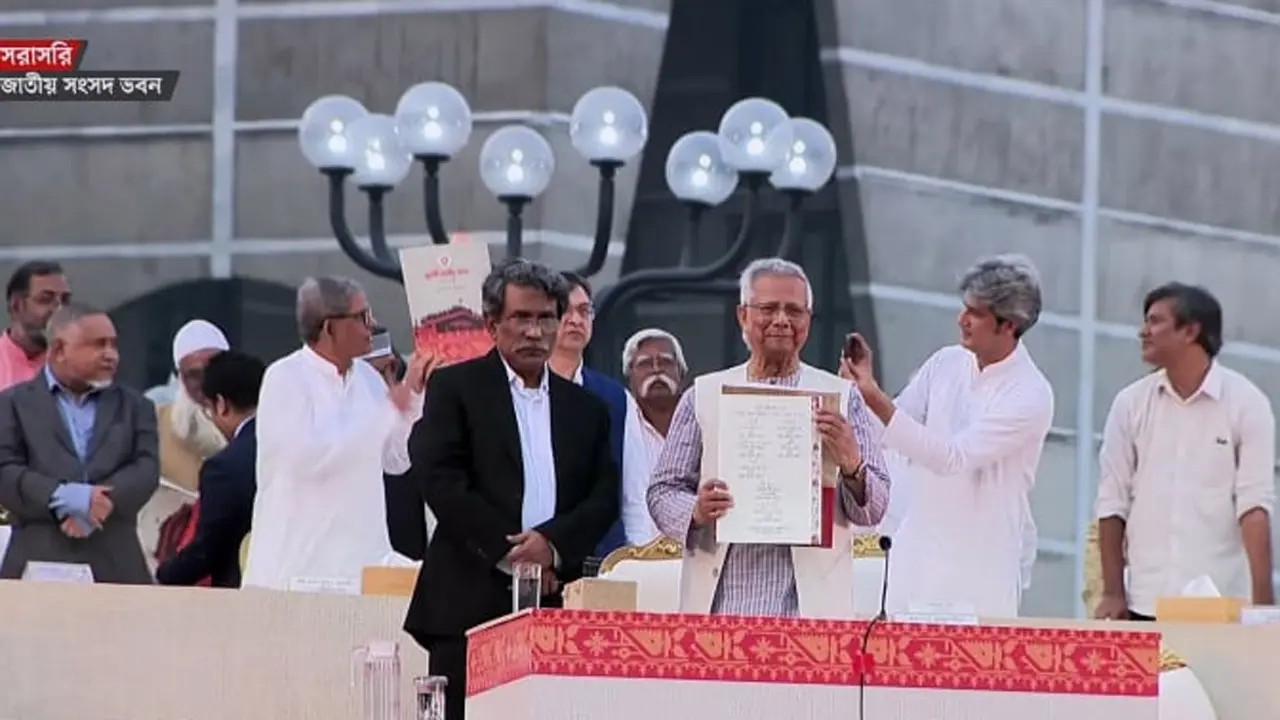
Photo: July Certificate Signing Ceremony
On the other hand, although the Gano Forum was present at the signing ceremony, they refrained from signing. Before the signing ceremony, they stated that the telegram regarding the declaration of independence by Bangabandhu Sheikh Mujibur Rahman on March 26, 1971, and the declaration of independence of the Mujibnagar government on April 10, 1971, would be included in the July Accord—if this was not confirmed, they would not sign. Later, on October 19, they signed the Accord.
8.
How was the proposed July document? There is not much opportunity for detailed discussion on this matter in this writing. However, it would not be irrelevant to shed light on a few points, I believe.
When the reform commissions were formed, the discussion had already arisen that many important issues might be left outside the reform agenda. For example, the 'Education Policy Reform Commission' or the 'Land Reform Commission'. Yet, what was the true reflection of the reform commissions that eventually took place in the July Accord? It should be said with regret, no.
Out of 11, 5 (7-11) commission recommendations have not even been included in the agenda of the National Consensus Commission. In fact, the mention of these commissions has not even been included in the main text of the charter. Among them, the two most important commissions are related to the labor sector.
The Daily Star Bangla, '4 Leftist Parties Will Not Sign the July National Charter', October 15, 2025
The Reform Commission and the Women's Reform Commission. These two commissions are important because one of the main forces behind the success of the July uprising was the women and the working class. There is also recognition of this in the context of the July Charter and the July Declaration. Therefore, the people hoped that the rights of these two classes would be emphasized in the reform agenda of the new Bangladesh. However, in reality, nothing of the sort happened. Instead, there were demands from right-wing and Islamist parties to abolish the entire commission based on some recommendations of the Women's Commission, and at one point, the government adopted a submissive stance on this issue.
Moreover, almost no policies related to health, education, and the economy have been included in this document. According to lawyer Jahed Ikbal, "While the issues of the constitution and state reforms have been emphasized in this July document, the aspirations of the general marginalized population and women have not been reflected at all. Additionally, the voices of grassroots people have not been adequately represented in this document." Economist Professor Mostafizur Rahman believes that while there was an opportunity to directly address the issues of health, education, and economic reforms for the general public, these are absent in this document.
Another very serious flawed aspect of the July Accord is that while it has given significant importance to the distribution of power or the transfer of power among politicians and the elite class, it has not given as much importance to the right of ordinary people to live with dignity as citizens of the state. It is noteworthy that we believe the issue of peaceful power transfer is one of the main reasons for the political crisis in Bangladesh. However, the Accord seems to present this as the only 'cause,' as it has only attempted to find a solution to this one problem. For this reason, Syed Nizar, an associate professor of philosophy at Jahangirnagar University, has referred to it as 'a document of the political barons of Bangladesh.' According to him, there is a similarity between the July Accord and the 'Magna Carta' of 1215. Just as the 'Magna Carta' was not a document of the rights of the common people (peasants or subjects), but rather a political compromise between King John and the barons (the elite class); similarly, the political reforms and declarations following July have turned into a document for the interests of political parties and the elite class (whom he refers to as 'barons') rather than the aspirations of the common people of Bangladesh. According to Nizar's analysis, there are two main problems in the state of Bangladesh, which intensified during the rule of the Awami League—keeping the people away from politics (politicization) and not considering the people as 'human beings' (dehumanization). Ordinary people and students participated in the uprising primarily to ensure their 'right to life' or security of life and to escape state oppression; in short: to reclaim their lost 'human dignity.' However, the discussions and commissions on post-uprising reforms are focusing on the process of power transfer (such as whether there will be an upper house in Parliament, what the voting system will be, etc.) and on preventing politicization. The main demand of the common people, the 'right to live,' has become secondary there. Although the current reform proposals attempt to bring back politics, they are not sufficiently strict or clear regarding preventing dehumanization or ensuring the security of citizens' lives and property.
- BBC Bangla, 'How much change can the July Accord bring to the lives of ordinary people?', October 19, 2025
-
Which is a fundamental principle mentioned in our Declaration of Independence and the July Declaration. Additionally, in the chapter titled 'The Independence of Bangladesh' of the Bangladesh and Global Studies book for the 9th-10th grade in 2026, a new section titled 'People's Uprising in Independent Bangladesh' states: “The essence of this (July People's Uprising) spirit is democracy, equality, social justice, and human dignity.”
and preventing depoliticization, etc. The main demand of the common people, the 'right to live,' has become secondary there. Although the current reform proposals attempt to bring back politics, they are not sufficiently strict or clear regarding preventing aviation issues or ensuring the safety of citizens' lives and property.
As a result, we see that although there has been much discussion following the coup regarding the 1972 Constitution, there is no clear proposal in the July Accord concerning one of the major flaws of this constitution, the chapter on citizens' fundamental rights. The Accord only states that "the expansion of citizens' fundamental rights, their protection, and the establishment of constitutional and legal measures for their implementation will be ensured." However, there is no specific proposal in the Accord regarding how this will be achieved. Although the report of the National Consensus Commission includes detailed recommendations from the Constitutional Reform Commission and five selected recommendations for discussion by the Consensus Commission, these are not mentioned in the Accord. As a result, these recommendations have effectively become worthless.
Even the 'Special Powers Act of 1974', known as the black law of Bangladesh, under which the government is granted a license to detain any citizen indefinitely without an arrest warrant, has not been mentioned in the July Accord, despite being the most abused law since independence. Although the Consensus Commission's report recommends its repeal, it was not included in the July Accord. Instead, during the first 8 months of the interim government, 37 people were arrested under this very law.
Poet and thinker Farhad Majhar has also referred to the July Accord as a 'political compromise of looters and mafia classes.' According to Farhad Majhar, this government, formed through the process of 'constitutional counter-revolution,' has drafted this accord as part of a compromise with the existing looters and mafias, excluding the aspirations of the mass uprising; therefore, it is 'anti-people.' He writes: "It is clear that the so-called July Accord is merely a political compromise with various competing groups of looters and mafia classes under the supervision of the United States." He further believes that the July Accord has "deliberately excluded commissions and sectors related to the interests of the people." Majhar's criticism of the July Accord stems from his fundamental perspective on the July mass uprising and the interim government; his views on the July declaration are also similar. According to Farhad Majhar, the previous constitution
- Syed Nizar, ‘Memorial Lecture 2 of Habibur Rahman, Founding Editor of State Thought: July Declaration and Charter: Document of the Political Barons' Accord of Bangladesh’, Sirajul Islam Lecture Hall, University of Dhaka, October 31, 2025.
- To learn about the criticism of the 'Fundamental Rights' provisions of the 1972 Constitution, see: Abul Mansur Ahmed, Buying at a High Price and Selling at a Low Price is Our Freedom, 'Let the Democratic Tradition of the Awami League be Preserved in the Constitution', pp. 51-57
- July National Certificate 2025, October 17, 2025, p. 6
-
BBC Bangla, 'Concerns over cases and arrests under the controversial Special Powers Act even during the interim government', April 18, 2025
According to this, the government is illegal, and therefore it does not have the authority to amend the constitution while maintaining constitutional continuity. Rather, this government should have assumed sovereign power and drafted a new constitution. In other words, the way Farhad Majhar views July as a popular revolution, that reflection is not found in the July Accord.
9.
Let's discuss some more aspects of the July document's content.
According to David Bergman, some of the criticisms previously mentioned regarding the political history of Bangladesh as described in the 'July Declaration' are taken into account in the 'July Charter'. For instance, the background section of the Charter does not mention the 'drafting process' and 'structural weaknesses' of the 1972 Constitution referenced in the Declaration. Additionally, while the Declaration does not mention the military coup of 1975, the July Charter does. Furthermore, although the July Declaration identifies the events of November 7, 1975, as a 'united revolution of the soldiers and the people', the July Charter avoids this. The Charter also does not mention the mass uprising of 1990. In this regard, it can be said that while the Declaration became a symbol of the 'struggle for the capture of history', the Charter did not achieve that status.
In the declaration, although the name of the 'Anti-Discrimination Student Movement' is mentioned as the platform leading the July mass uprising and various programs they announced during the uprising are referenced, these are not mentioned in the July Accord. In response, the Anti-Discrimination Student Movement claims that there has been 'distortion and rewriting of history' in the July Accord. They also assert that the families of the martyrs, the injured, and the students from July have been ignored in the decision-making process of the reform. They further allege, "There is a delay in completing the signing quickly without resolving the legal basis of the July Accord and the note of dissent." Their allegations align with those of the NCPI.
Although the number of martyrs is stated as 'almost one thousand' in the declaration, the draft of the July document initially mentions 'more than one thousand four hundred' and later refers to 'thousands' in the final copy. Additionally, while the declaration does not specify the number of injured, the July document states that 'more than twenty thousand' were injured. The fact that the number of martyrs in July could become a point of 'debate' in the coming days is indicated by the use of two different types of language and tone in two important state documents. Arriving at such a contradictory state of national documentation at this time is indeed an embarrassing experience for us.
- Farhad Majhar, ‘July Accord: Political Compromise of Looters and Mafia Classes?’, Journal of Thought and Action, Volume 1, Issue 6, October 23, 2025
-
Prothom Alo, 'Condemnation of 'Distortion and Rewriting of History' in the July Accord by the Anti-Discrimination Student Movement', October 17, 2025
In addition, while the July declaration and the draft of the July charter mention the formation of an interim government "according to Article 106 of the existing constitution," this was omitted from the final copy of the charter. One of the seven reasons that the four leftist parties refrained from signing the charter is this. Many believe that the omission of the reference to Article 106 from the final copy of the July charter was a planned move by the government. This leaves ambiguity regarding the nature of the interim government in the July charter.
Immediately after the July mass uprising, the issue of the constitution came to the very center of the state's reform activities. The 1972 constitution became the focal point of all the state's misfortunes—such a campaign gained considerable strength. There are logical reasons for this. The constitution was an important pillar of Sheikh Hasina's fascist rule. Several significant changes were made to the 1972 constitution through the Fifth Amendment. Sheikh Hasina, while claiming to return to the 1972 constitution, introduced the Fifteenth Amendment in 2011 based on a court ruling; through this, she abolished the caretaker government system—which is seen as the starting point of Sheikh Hasina's authoritarianism in the political context of Bangladesh. I have previously mentioned that the constitution is one of the reasons for our political crisis, and a vigorous political campaign regarding this had been ongoing for several years. Moreover, the July mass uprising itself created a kind of constitutional crisis in the country. As a result, it is only natural that the constitution became the focal point of discussion after the uprising. The crisis and potential of the post-uprising Bangladeshi state turned into merely a 'constitutional crisis and potential.' This is also reflected in the July Accord prepared by the National Consensus Commission later on. Among the total of 84 reform proposals mentioned in the Accord, 47 are related to constitutional reform. Consequently, the entire reform agenda essentially transformed into a kind of 'constitutional reform agenda' or 'new constitution agenda.' This led to various complexities surrounding the entire reform process. I will return to that discussion later.
Let’s say for now: The agendas related to constitutional reforms raised in the July Charter were not merely associated with good governance, civil rights, or decentralization of power. Rather, various ideological debates have also been included in the Charter's agenda, which has created unnecessary controversies and confusion regarding the July Charter; at the same time, it has disrupted the main purpose and direction of the reforms. Let’s provide two examples.
The 1972 Constitution had four fundamental principles for state governance: Bengali nationalism, socialism, democracy, and secularism. There has been considerable debate over these principles both before and after. Due to Sheikh Mujibur Rahman's unpopular rule, these principles of the 1972 Constitution also became quite unpopular. Later, through the Fifth Amendment, the other three principles were changed, except for 'democracy'; they were reinstated in the Constitution through the Fifteenth Amendment. These issues related to the fundamental principles of state governance are quite sensitive and ideologically charged; moreover, they pertain to the governance of the state or rulers.
- See details: Ali Riaz, 2021; Badiul Alam Majumdar, The Politics of Abolishing the Caretaker Government System, Prothoma, 2023
The connection of these with good and bad is very minimal. Nevertheless, the principles of state governance are included in the agenda of the consensus commission. Initially, the commission proposes five principles: 'equality, human dignity, social justice, pluralism, and democracy.' 'Bengali nationalism' is already quite unpopular as a principle; and among 'equality, human dignity, and social justice,' the core connotation of 'socialism' exists. However, for various reasons, even though 'secularism' (which is a major characteristic of any modern nation-state) was excluded, it seemed naturally essential to the consensus commission to include a word with a nearly identical meaning in the constitution. As a result, the arrival of 'pluralism' occurs.
However, the right-wing or Islamist parties in Bangladesh have not taken this 'pluralism' term, which has a 'secular' connotation, well; because the main element of these parties' vision of the state is religious supremacy. As a result, they veto this principle. The BNP, which has already been in an adversarial position with the consensus commission, sees this as an opportunity and campaigns in favor of 'full faith and trust in Allah,' which was added in the fifth amendment instead of 'pluralism.'
As a result, ultimately 'pluralism' is abolished. In its place, 'religious freedom and harmony' is added. However, according to Article 41 of the Constitution, the religious freedom of all citizens has already been recognized. Therefore, there is no reason to make it a fundamental principle. But perhaps the commission has undertaken this task out of the shame of not being able to replace 'secularism' with 'pluralism'. We believe another complexity has arisen here. 'Religious freedom and harmony' are fundamental rights; as stated in the Universal Declaration of Human Rights, they are also present in the existing constitution. Consequently, by making fundamental rights a principle, the entire category of 'principles' has effectively been rendered ineffective, or its essential substance has disappeared.
However, the section related to principles in the charter remains quite vague. It states that, "The principles of state governance in the constitution will include 'equality, human dignity, social justice, and religious freedom and harmony'." The question is: will these be added in place of the previous principles? Does that mean that 'democracy', the most important principle of state governance, has been omitted? Or will these be added alongside the previous principles? If the BNP comes to power, it is likely to be the latter. Because Mr. Salahuddin Ahmed, a member of the BNP's standing committee, has said, "Whatever the principles of state governance may be determined, they must be taken in the National Parliament. At the same time, we agree with the recommendations made by the consensus commission. ...We agree with the principles of state governance adopted during President Ziaur Rahman's time in the fifth amendment of the constitution, and we want to bring that back. ...We also agree with the few lines and words that the consensus commission has added to these. We are willing to accept this." And if that happens, 'democracy' will also return to the principles of state governance.
- Jagonews24, 'The fundamental principles of state governance will be determined in Parliament: Salahuddin Ahmed', August 1, 2025
But what if someone else comes to power? What if they say that we will only keep what is in the July Accord in principle—then what will happen? Will 'democracy' return to the principles of state governance? The commission or we do not have the answer to this question.
Let's look at another example. The draft of the July document states that Article 150 (2) of the Constitution will be repealed; as a result, the 5th, 6th, and 7th schedules will not remain in the Constitution. It is noteworthy that in 2011, through the fifteenth amendment, Sheikh Mujibur Rahman's speech of March 7 and the declaration of independence sent via telegram were included in the 5th and 6th schedules, and the declaration of the Liberation War was included in the 7th schedule. Immediately after the draft of the document was published, many raised objections regarding this matter. The question naturally arose in discussions, meetings, and seminars from various political parties and public forums: why is the declaration of independence being excluded from the Constitution? However, the commission did not take the matter seriously. Later, when the leftist parties formally objected to this issue, the proposal was amended after the signing of the document; and it was decided to keep the 7th schedule, that is, the declaration of the Liberation War, in the Constitution.
10.
From the beginning, there was disagreement among political parties regarding the implementation process of the July Accord. The BNP wanted the next parliament to implement the Accord constitutionally. On the other hand, Jamaat and the NCP demanded the legal basis of the Accord be established before the elections. Without making any decision regarding the implementation process of the July Accord, the government organized a signing ceremony. Due to the unclear legal basis of the Accord, the NCP boycotted the event and refrained from signing the Accord. Although Jamaat sought a legal basis, they ultimately signed the Accord.
The NCP initially speaks of the Constituent Assembly in the context of implementing the July Accord; on the other hand, the Jamaat wants a Provisional Constitutional Order or PCO. Amid ongoing discussions about the implementation process, Jamaat and seven other like-minded Islamist parties began a movement based on the July Accord for elections in February (i.e., implementation of the Accord before the elections), with five demands including PR in the lower house that are outside the agenda of the Consensus Commission. On October 19, 2025, NCP's convener Nahid Islam described Jamaat's movement for PR as a 'calculated political deception.' He alleged that Jamaat is using the issue of reform for party interests. However, later they joined Jamaat's electoral alliance based on 'consensus on the reform issue.'
Subsequently, all parties agree on the legal implementation of the July Accord through a referendum. However, a disagreement arises between the BNP and the Jamaat and NCPI regarding whether the referendum will take place before or after the elections. At this stage, 13
- Prothom Alo, 'The Jamaat's Movement Regarding PR is Deception: Nahid', October 19, 2025
The government issued the 'July National Charter (Constitutional Reform) Implementation Order, 2025' in November. This order also creates various complexities and ambiguities in the implementation of the July Charter.
First of all, questions remain regarding the constitutional basis of the order. According to the existing constitution of Bangladesh, there is no provision for the President to issue such an order. As a result, this very order faces the risk of being challenged in court later on. Two days before the issuance of the order, on November 11, BNP Standing Committee member Salahuddin Ahmed stated at a press conference, "Even if published in the form of a gazette, the legal basis of such unconstitutional orders will be weak."
Secondly, the referendum has provided an opportunity for a single answer to four questions, which has given rise to various complexities and questions. In parts 'a' and 'b' of the questions, certain issues have been brought up in the referendum that had the BNP's 'note of dissent.' According to the BNP, this is contradictory to the July Accord; because the Accord was created with the 'note of dissent' included, and it was clearly stated that each party would have the opportunity to campaign according to their 'note of dissent' in their electoral manifesto and would be able to amend the constitution accordingly if they won. This has created a contradiction between the Accord and the implementation order of the Accord. As a result, the BNP claims that if they come to power, they will not be bound to implement anything outside the July Accord.
Thirdly, even if the referendum results in a 'yes', the constitution will not be automatically amended. Instead, a 'Constitutional Reform Council' will be formed with elected members of parliament. This council will have 'constitutional authority', and it will be obligated to amend the constitution within 180 days. The question is: if there is 'constitutional authority', then why will this council be obligated to amend the constitution within 180 days according to the July Accord? Can this limited power to add certain predetermined matters to the constitution truly be called 'constitutional authority'? It is clear that the commission has brought this proposal to uphold the demands of the NC's constituent assembly. However, they have not considered the self-contradiction of the matter at all. Furthermore, what will happen if the council does not amend the constitution within 180 days? There is no answer to this question anywhere.
However, the journey does not end here. Rather, much depends on the upcoming elections and the parliament. In fact, Bangladesh's political history is filled with incidents of 'political agreement' violations. As a result, we are left with some additional concerns: since the constitution will not be automatically reformed through this referendum, there will be an opportunity for another referendum according to Article 142 after various reform proposals are implemented by the elected parliament. Furthermore, the interim government is campaigning for a 'yes' vote in the referendum under the justification of the coup mandate. This raises questions about whether the results of the referendum will be fair and credible. Supreme Court lawyer Dr. Shahdin Malik has stated, "If the 'yes' vote wins in the election, then someone could go to court. They could go and say
- Daily Observer, ‘No obligation to follow decisions beyond July Charter: BNP warns government’, 11 November 2025
The elections in this part were not conducted fairly. The reason is that the government campaigned in favor of it. There was no level playing field in the public vote. Morally, the government should refrain from this.” This sentiment is echoed by many, including Shahdeen Malik. The government is also responding to this. For instance, Professor Ali Riaz, the head of the Constitutional Reform Commission, co-chair of the National Consensus Commission, and special assistant to the chief advisor (advisory rank), stated, “The July National Charter is not just a document printed in black letters on paper; it is the cry of the families of those who have been missing for over 16 years and was created in exchange for the blood of the martyrs of the mass uprising of July-August twenty-four. Therefore, the interim government can campaign in favor of the public vote based on this charter.” He also mentioned that there are no legal barriers for government employees to campaign in favor of a 'yes' vote in the referendum. The government has also stated that the support of the interim government's chief advisor for the 'yes' vote in the referendum is consistent with the democratic practices of Bangladesh. Citing various global precedents, it is said, “These events are not seen as violations of democratic norms, but rather as a natural expression of responsible political leadership.” They stated, “The biggest risk for Bangladesh at this crucial time is not support, but rather hesitation and silence. If the reforms for which the interim government has taken responsibility are not supported, public trust will be eroded, voters will be confused, and the continuity of change will be disrupted. …Ultimately, the decision is for the people of Bangladesh. This is the guarantee of democracy. Leadership does not take away that decision; rather, it helps to clarify and give meaning to it.”
However, the question remains. If 'no' wins in this process, there is a significant possibility that the entire agenda of reform will be under threat. On the other hand, setting aside the debate about whether the government can campaign, another trend needs to be mentioned. The way or the language in which the campaign is being conducted for the 'yes' vote clearly reflects an 'exclusionary' or 'alienating' stance. Those who will vote 'no' are labeled as fascists, or 'those who support the July movement are all in favor of the 'yes' vote, and those who support fascism will say 'no', or if 'no' wins in the referendum, fascism will return—this kind of campaign has two harmful aspects. First, the practice of labeling 'no' votes as fascist may start again. There may be many who supported the July coup, who are in favor of reform, but are against the proposal that has been put forward—then they are being 'excluded' from the entire political discourse. There may also be many who were against Sheikh Hasina, but do not see the 1972 constitution as the source of the crisis; rather, they believe that Hasina has become such a dictator because she does not adhere to the constitution—what could their position be? If they vote 'no', then what about them?
- Dhaka Stream, 'Upcoming Referendum from July Accord, Government's Bias'; January 17, 2026
- Bengal News, 'The July Accord was created in exchange for blood, the government can certainly promote a referendum: Ali Riaz' January 17, 2026
- Prothom Alo, "There is no restriction on government employees campaigning for the 'Yes' vote: Ali Riaz," January 18, 2026
- Prothom Alo, 'The government explained the chief adviser's support for the 'yes' vote in the referendum', January 18, 2026
- Samakal, 'Vote 'Yes' for the July Accord Against Fascism: Advisor Adilur', January 16, 2026
- Prothom Alo, 'Special Interview: Monir Haider', January 11, 2026
Will it be labeled as ‘fascist’? The horizontal character of the coup, along with this type of campaigning and the state-sponsored labeling, is a warning sign for the linguistic expression of the political landscape in Bangladesh. On the other hand, simply voting ‘yes’ will not bring fascism back, nor will voting ‘no’ bring it back, or lead to enforced disappearances and killings—this kind of horrific simplification will only exacerbate the crisis of political culture in Bangladesh. Constitutional reform is urgent; however, there are countless examples worldwide showing that even very good constitutional reforms or drafts cannot prevent tyranny or fascism. Without paying any attention to the unwritten political agreements, compromises, and processes of environmental reform that can keep their fruits alive, the campaign is being conducted merely through rhetoric and the production of a ‘fear’ of the return of fascism. The political language in Bangladesh has already become exclusionary; we believe that this campaign strategy is not diminishing it but rather increasing it. Observing the nature of the campaign, a commentator might find this question relevant: “If authoritarian rule returns in the future even after voting ‘yes’ for this product or reform proposal, will the individuals in the interim government who prepared it take any responsibility?”

Image: Government campaign in favor of the referendum
From the beginning, due to the BNP's 'note of dissent' on some important issues and their demand for constitutional reforms through an elected parliament, the Jamaat and the NCP have portrayed the BNP as 'anti-reformist.' The disregard for several of the BNP's 'notes of dissent' in the implementation order of the charter has led to dissatisfaction within the BNP regarding the July implementation order. Initially, many BNP leaders and activists refused to accept this order and shared photo cards with 'no' written on them on social media. As a result, their opponents got another opportunity to portray the BNP as 'anti-reformist.' On the other hand, the BNP claims that they will only accept what is in the July charter. Therefore, if the BNP wins the election, there is a possibility of further complications in the charter implementation process. In this political chess game, the July charter and the implementation order may even end up in court.
Imran Azad, 'Why Does the Interim Government Want a 'Yes' Vote Victory', Prothom Alo, January 16, 2026
11.
This process has effectively turned the July Accord or the reform agenda into a 'bargaining chip' for political parties with the government in the lead-up to the elections, as well as an electoral 'tool' for campaigning in the voting field. Although the NCP is campaigning for a 'yes' vote on the July Accord, they have not actually signed it. It seems that they are prioritizing the implementation order of the Accord rather than the Accord itself—since it mentions the removal of several 'notes of dissent' from the BNP, as well as the Constitution Reform Council. On the other hand, while the BNP has signed the July Accord, they have expressed discomfort regarding the implementation order of the Accord.
The Jamaat has maintained consensus on all reform agendas from the beginning for primarily two reasons: first, the reform agendas of the July Accord have brought about changes in the constitution that are beneficial for Jamaat in the current situation; second, the agendas of the Accord have primarily curtailed the power of the ruling party, which has put larger parties like BNP in a difficult position. However, Jamaat has taken a strategic position in this regard: on one hand, they have signed the July Accord along with a 'Note of Dissent', while on the other hand, they have not shown any particular reaction to the NCP's refusal to sign; rather, they have created pressure on BNP by supporting the NCP's position in principle. Some leaders of Jamaat have even praised the NCP for not signing. Throughout the entire process of the consensus commission's reform discussions, Jamaat has maintained alignment with the NCP's opinions; the NCP has also been unable to establish a separate position on the reform issue. Therefore, it is natural that they have entered into an electoral understanding with Jamaat. However, the question remains as to how much Jamaat truly believes in these reforms from the standpoint of their party policy and ideology, for various reasons. One example of this is that despite a widespread campaign portraying themselves as 'reformist', Jamaat has not nominated a single woman as a candidate in this election; yet according to the promises outlined in the July Accord, they were supposed to nominate at least 5% women candidates. The same applies to the NCP. In contrast, the percentage of women candidates from BNP is much higher than that of these two parties. As a result, the question of how genuine the reform issue is for political parties, and how much it is merely a 'tool' for electoral campaigning, has begun to arise.
12.
The journey from the July declaration to the July charter is actually the main political event of Bangladesh's interim government period. Many minor issues related to it are being debated, and likely will continue to be. This is the main characteristic of a democratic society and political landscape. However, despite the tensions and uncertainties (which we discussed in detail above), we acknowledge that these two events represent an unprecedented moment for Bangladesh's political landscape. Since its inception, the state of Bangladesh has been giving rise to a violent political environment surrounding numerous issues, including the transfer of power. No political crisis has been resolved through dialogue and consensus among our main political entities. We have seen at various times that a kind of 'dialogue' was created under the 'mediation' of foreign ambassadors, but that 'dialogue' never reached a consensus. In other words, our political landscape has never been able to resolve its crises on its own. For the first time, we see all parts of Bangladesh's political landscape attempting to come together to make a decision without the mediation of 'foreign' powers. Those with significant power and those with no power at all are all sitting together to decide how to govern the state based on dialogue and consensus. This 'mature' political society of Bangladesh is perhaps the greatest gift of the July popular uprising. There is no doubt that the written results we have obtained through this consensus also have various limitations; however, the fact that we are trying to find our own path peacefully and based on consensus is a testament to our progress. On the other hand, the limitations and weaknesses in the two agreements—the declaration and the charter—are actually a reflection of our collective intellectual and political weaknesses and limitations over the past few decades. The essence of democratic politics and the political landscape is dialogue and negotiation. Without dialogue and negotiation, even very 'good' things create a feeling of being 'imposed.' The aspirations that have arisen in the public regarding the July charter depend on how much this culture of 'dialogue' and 'consensus' can be practiced and developed. Whether this kind of unity on reform issues will ultimately be maintained, or how much reform will actually be possible—though it cannot be said with certainty yet, we want to see hope. We want to hold onto hope.
July Declaration and Charter: A ‘Political’ Reading