
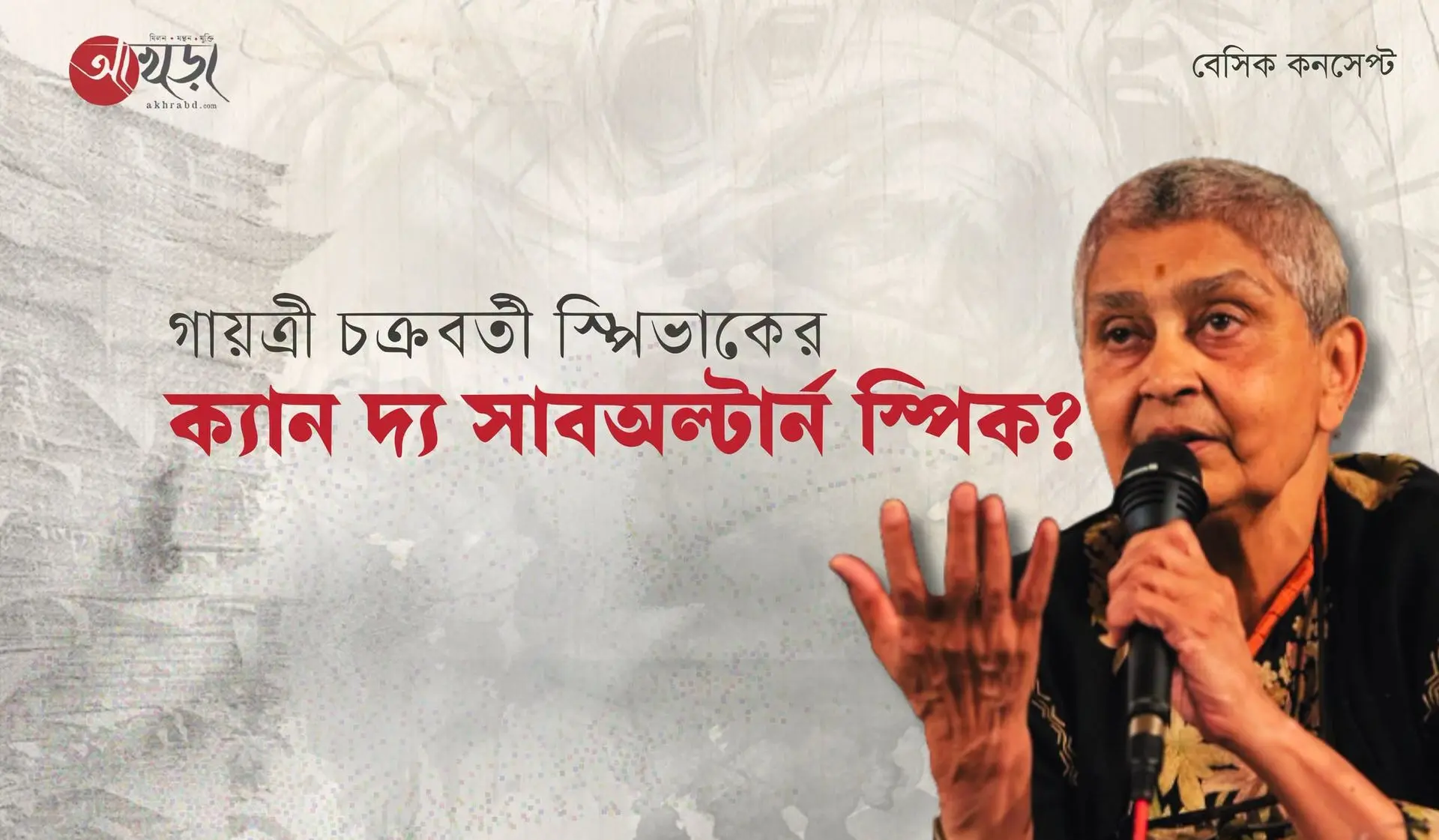
Spivak’s “Can the Subaltern Speak?”
[Note: Gayatri Chakravorty Spivak is a renowned literary critic and feminist theorist, and one of the most influential figures in postcolonial studies and poststructuralism. For various reasons, Spivak is a highly familiar name in Bangladesh. Her famous essay “Can the Subaltern Speak?” is equally well known. Although widely recognized, the essay has perhaps been relatively little “read” and even less “studied” in Bangladesh. Considering its relevance and timeliness, this discussion on the essay is being published for the readers of Akhra as part of the “Basic Concept” series. The article has been prepared based on Graham K. Riach’s booklet An Analysis of Gayatri Chakravorty Spivak’s Can the Subaltern Speak? The Akhra team translated important sections of the booklet with the assistance of AI and prepared the complete article through further editing. ]
Who Is Gayatri Chakravorty Spivak?
Gayatri Chakravorty Spivak, the author of the 1988 essay “Can the Subaltern Speak?”, was born on February 24, 1942, in Kolkata. Exactly five years later, India gained independence from British rule. Her early experience of life in India may have played a role in shaping her later interest in the “subaltern,” or marginalized and lower social classes.
Spivak is one of the best-known figures among the “Holy Trinity” of postcolonial studies, the other two being Edward Said and Homi Bhabha. She is also one of the foremost theorists of Subaltern Studies.
In 1959, before she had even turned 18, Spivak earned a first-class honors degree in English literature from the University of Calcutta. At the same time, she received gold medals in both English and Bengali literature. Later that same year, she left India for the United States and earned a master’s degree from Cornell University in New York State. She subsequently completed a one-year fellowship at Girton College, University of Cambridge, in Britain, and then returned to the United States to earn her PhD from Cornell University. Her doctoral supervisor was the renowned deconstructionist philosopher Paul de Man.
After completing her PhD, she taught at several universities in the United States. At the same time, she emerged as a translator and postcolonial theorist. She currently serves as a professor in the Department of English and Comparative Literature at Columbia University in New York City.
Alongside her academic career, Spivak is also a political activist and educator. In her work, theory and practical application go hand in hand. She has established several schools in the Indian state of West Bengal and has also taught in many other places, including Algeria and China. Academics generally spend much of their careers within the comfort and security of university campuses. However, through her practical decision to work directly with poor communities at the grassroots level, Spivak has set a distinctly different and exemplary model for pursuing an academic career.
Author’s Background
The most important historical factor that influenced Spivak’s career was perhaps India’s anti-colonial or independence movement, which gained momentum in the late nineteenth century and ultimately led to independence in 1947. According to one scholar, “This political context of pre-independence Kolkata shaped Spivak’s earliest childhood experiences.” Spivak was born in 1942 in a hostile environment marked by intense public discontent over the Bengal famine, which claimed the lives of millions, while anti-colonial nationalist movements were simultaneously gaining momentum.
In the decades following independence, the long-term effects of colonial rule on India became increasingly evident. These included persistent ethnic and religious conflicts, a legacy of institutional violence within the legal and governance systems, the continued use of English in university curricula, and the ongoing oppression of minority groups. Spivak was deeply aware of the extent of the wounds that colonialism had inflicted on Indian society and of the fact that these wounds had not been healed even after the apparent liberation brought by independence.
Moreover, as a comparatively privileged middle-class Hindu woman, her experience in this environment makes her sensitive to the subtle and internal differences among formerly colonized individuals. Spivak chooses to make raising a voice against these oppressive systems the central mission of her life. In pursuing this goal, she applies her philosophical and critical tools in such a way that they can undermine Western 'cultural imperialism' from the ground up.
What did 'Can the Subaltern Speak?' say?
Spivak's essay title "Can the Subaltern Speak?" is somewhat misleading. It certainly examines whether the lower classes can speak, but its main concern is whether their words actually reach anyone's ears. Spivak argues that several obstacles stand in the way of hearing their voices. The most significant reason is that relatively powerful members of society (such as academics, religious leaders, or any other privileged class) always speak on their behalf.
This elite class essentially takes away the voice of the lower class. If the lower class could speak for themselves and had a platform or medium where their voices would be heard (this is what is meant by 'speak' in the title of the essay), then, according to Spivak, these people could have gained an effective political voice.
Spivak has combined the concepts of Marxism, feminism, and deconstruction in this essay. These specific fields have helped her to argue about the oppression created by the differences in opportunities for power, gender, and knowledge acquisition.
She has demonstrated how institutional research, particularly Western research, always misrepresents the so-called 'Third World' or developing countries. At the same time, she has shown why women from lower classes are doubly marginalized or cornered (first as victims of colonial rule, and second as women). Spivak here highlights what she terms 'epistemic violence.' This is a form of violence that is imposed not through physical harm, but rather through thought, discourse, and writing.
According to Spivak, a striking example of epistemic violence is the exclusion of the subaltern from historical narratives. When oppressed people are not allowed to speak for themselves or when their contributions are not recognized in history, their existence is effectively erased from the world. This is even more pronounced in the case of subaltern women. In Spivak's words: 'If there is no history of the subaltern in the context of colonial production and they cannot speak, then a subaltern person as a woman is lost deeper in the darkness.' According to Spivak, women become silent or voiceless under the pressures of both colonialism and patriarchy.
Spivak has concluded that "the subaltern cannot speak." This is because those in positions of power always speak on their behalf, and they can never represent themselves. Moreover, even when they do speak, they are not heard. Spivak views "speaking" as a two-way exchange between the listener and the speaker. She writes: "When you say (they) cannot speak, it means that if both speaking and being heard are involved in the process of speaking, then the possibility of this response or accountability is completely absent in the realm of the subaltern." For example, a poor farmer might say, "No matter how hard I work, my family cannot eat enough." But will this statement reach anyone's ears in a way that will begin to bring about change in society? For any statement to be successful, it is crucial that its message is conveyed properly. According to Spivak, the voices of the subaltern fail to fulfill this purpose.
This essay by Spivak is one of the fundamental and authoritative texts of postcolonial theory. It has been repeatedly published in various collections of his writings. It has been translated into many languages, including Spanish, German, Chinese, and Hebrew, and it is almost invariably included in any anthology of postcolonial studies. The essay "Can the Subaltern Speak?" is unique because it creates an extraordinary synthesis of deconstructionist and feminist thought in a sharp critique of the social, cultural, and political impacts of colonialism.
Context of the essay
Gayatri Chakravorty Spivak's essay is an interdisciplinary work that integrates Marxist and feminist perspectives with philosophy and history. As a result, it is only natural that this writing will be considered a significant and foundational text within the broad academic field of post-colonial studies. This post-colonial studies framework brings together those who have worked on the social and cultural impacts of colonialism and post-colonialism under one umbrella. For example, what they attempt to do is:
- A revisionist reading or a comprehensive reassessment of Western history
- Highlighting the lasting impact of colonial past on the present
- Making readers aware of the blindness or limitations of their own cultural perspectives
- Rejecting and condemning the ongoing imperialism even today
Spivak was one of the pioneers in using postcolonial perspectives in literary reading or text analysis. Before her work, the literature of newly independent countries was largely considered as the literature of former colonizing countries and their former colonies; for example, the literature of numerous former British colonies was referred to as "Commonwealth literature." This categorization was quite problematic because it presented English literary theory from a Eurocentric perspective: it maintained a "center-periphery model" of culture, where the culture of the colonizing country was assumed to be primary and superior. The concept of "Commonwealth literature" also overlooked the fact that British literature itself was part of the Commonwealth, and there was no strong critical perspective present within it. Postcolonial literature—which partially began with the essay "Can the Subaltern Speak?"—might be seen as a perfect synthesis of Commonwealth literature and "critical theory," providing it with a robust theoretical framework.
General scope of discussion
Spivak's work in postcolonial studies owes a debt to several thinkers. The main wave of anti-colonial thought emerged in the 1950s and 1960s. Among them were theorists like Aimé Césaire. His essay "Discourse on Colonialism" (1955) sharply criticized the racist colonial narratives propagated in the name of civilization and progress. Also present was Franz Fanon, a resident of Martinique, his comrade, psychiatrist, and theorist. In his two books, "Black Skin, White Masks" (1952) and "The Wretched of the Earth" (1961), Fanon discussed the psychological damage caused by the imposition of Western values on local or indigenous people.
In terms of geographical location, Mohandas Karamchand Gandhi, the leader of India's independence movement, was closer to Spivak. His 1909 anti-colonial pamphlet 'Hind Swaraj' fiercely attacked European arrogance, strongly condemned Western modernity, and outlined a non-violent movement against British rule. Gandhi specifically did not want merely a 'British rule without the British'—that is, the maintenance of British social structures by Indians; rather, he sought a completely new model of society that would entirely reject European modernity.
Spivak has translated the writings of Séjean, written an introduction or preface for a film about Fanon, discussed his work, and provided positive quotes from Gandhi's 'Hind Swaraj' during discussions on violence in revolutionary movements. These three thinkers have significantly contributed to the intellectual foundation of the theoretical framework of post-colonial studies that emerged in the 1980s; additionally, Spivak has directly engaged with and critiqued their work in her own institutional writings.
Academic Influences
Although Spivak does not fully align herself with any specific intellectual tradition, the academic sources that have a direct influence on her can mainly be divided into three groups:
- Subaltern Studies Group.
- Post-structuralist philosophy, in which the names of French theorist Jacques Derrida and Belgian thinker Paul de Man are particularly noteworthy.
- Edward Said.
The 'Subaltern Studies Group' was formed under the leadership of historian Ranajit Guha. Among the early members were historians and political scientists, including Partha Chatterjee, along with many others. The group's aim was to write a 'history from below' that would foster the development of nationalist consciousness in India. In other words, the main focus of historical research was to shift attention from the elite class to the politics of ordinary people. By working in this way, their research attempted to give a voice to the marginalized people of India. Spivak had a long-standing connection with this group. While she broadly supported their work, she expressed some dissent regarding their methodology in her essay 'Can the Subaltern Speak?'
The second major influence on Spivak's work is the post-structuralist philosophy. Starting in the 1960s, as the works of Jacques Derrida, French social historian and philosopher Michel Foucault, gender theorist Judith Butler, and several other thinkers began to gain recognition in English-speaking universities, they were all collectively included in this school of thought. Most of them shared a common interest—uncovering the nature of the metaphysical assumptions and interpretations of language that influence our thinking. From the 1960s to the 1980s, these perspectives were popularized by the 'Yale School of Deconstruction,' led by Spivak's PhD advisor Paul de Man. The post-structuralist influence is evident in both Spivak's theoretical perspective (which attempts to dismantle established and certain concepts) and her writing style (which is often quite complex and obscure).
The third significant influence on Spivak's work comes from Palestinian-American thinker Edward Said. His book "Orientalism" (1978) played a crucial role in establishing the field of postcolonial studies. Said aimed to demonstrate that the Western representation of the East always misrepresents Eastern societies; because the methods employed by Europeans in research are intertwined with various misconceptions and prejudices. These perspectives on the East are not at all neutral; rather, they have been used to reinforce colonial rule and to portray a self-aggrandizing image of a civilized, clean, and productive West in contrast to a primitive, dirty, and passive East. This issue is extremely important for Spivak's essay, as it shows how oppression can be carried out not only through brute force but also through institutional or cultural means; and she elaborates on this argument in greater detail.
Moreover, the most important aspect of understanding the essay "Can the Subaltern Speak?" is that Said argues that the Western discourse or language surrounding the East has silenced the voices of the local people there and stripped them of their ability to represent themselves. Spivak's perspective is quite similar. However, while Said views the roles or identities of the colonizers and the colonized as relatively unchangeable, Spivak presents colonial identities as much more fluid and dynamic.
Contemporary Debate
Spivak's essay is directly connected to the thoughts of post-structuralist philosophers and the research of the 'Subaltern Studies' group. His methods are similar to those of cultural historians, as he analyzes cultural readings or texts to show how they support colonial ideologies—however, he has also raised strong objections to various aspects of this line of thought.
She has criticized the French post-structuralist philosophers Gilles Deleuze and Michel Foucault. According to her, they have significantly downplayed their own roles as academics or institutional figures in maintaining oppressive power structures. This may be somewhat surprising, as their own reputation was as radical leftist intellectuals, and they themselves have made similar criticisms of others. Spivak raises the question of whether the politics constructed to aid the oppressed groups in the West (such as the working class) are actually suitable for the lower classes in former colonies. At the same time, she expresses doubt about whether intellectuals can ever truly represent this voiceless population accurately and justly.
Even the 'Subaltern Studies Group' has not escaped this criticism. According to Spivak, the research methodology of this group was flawed for two main reasons. First, they mistakenly portray all subaltern people as if they are the same. In their attempt to create knowledge about the condition and consciousness of the subaltern, this group suppresses the vast diversity and differences within the subaltern class. In Spivak's words, 'the colonized subaltern subject is irretrievably heterogeneous' (meaning, the subaltern identity is not homogeneous). In fact, Spivak is quite cautious about imposing a singular or uniform perspective—a so-called 'subaltern perspective'—on what is a pluralistic and diverse group. She believes that instead of a single voice, there are multiple voices and different positions within the subaltern.
Secondly, by continuously using the terms 'subaltern' (lower class) and 'elite' (noble) as fixed or permanent categories, the Subaltern Studies Group inadvertently reconstructs the very inequalities in society that they aimed to erase. In their framework of thought, the concept of 'lower class' can only exist in opposition to the concept of 'elite,' and for that reason, it fails to achieve any independent identity or uniqueness free from the influence of the elites.
In short, those who have influenced Spivak are as much her allies or collaborators as they are her institutional adversaries. Although she has drawn ideas from various perspectives and fields of research, she subjects each idea to a very rigorous and intense process of questioning before integrating it with her own thoughts.
Main Subject Matter
Spivak defines the subaltern or the lower class as those people who are ‘removed from all lines of social mobility’—such as ‘illiterate peasant societies’, who have no access to education or other opportunities that would allow them to improve their position in society. In the essay ‘Can the Subaltern Speak?’, she raises the question of whether it is possible for the lower classes to have their voices reach others and thereby represent themselves. Her conclusion is that the global power structures, whether institutional, economic, or political, do not currently allow the lower classes to speak. Here, to speak or ‘to voice’ does not merely mean to utter something, but also to have one’s message recognized. Furthermore, any attempt by the powerful in society to give the lower classes a collective voice will distort their actual position and again take away the opportunity for the lower classes to speak for themselves.
Spivak's main argument brings to light the moral dilemmas created by representing others or speaking on their behalf. This may seem strange at first glance, as political representation should be a desired goal for the lower class, just like any group seeking to improve its position in society. However, Spivak's point is much deeper; she suggests that all forms of representation actually deprive the lower class of a fair hearing, and as a result, all their attempts to speak become meaningless. It is not that a lower-class individual cannot say anything personally, but rather that speaking from a lower-class position in society means that your voice will never be heard (at the center of power).
The Spread of Ideas
In this essay, Spivak argues that there are two commonalities between institutional research, colonialism, and patriarchy: the mistaken belief that their own values are universal, and the continuous silencing of the voices of the lower classes.
Spivak begins by showing how two leading radical intellectuals—French philosopher Gilles Deleuze and theorist and historian Michel Foucault—downplay their own institutional roles in maintaining Western cultural dominance over the rest of the world. Spivak argues that these two thinkers 'systematically ignore the question of ideology and their own entanglement in intellectual and economic history.' In other words, they see themselves as neutral observers, while in reality, they are biased towards Western values. For example, they assume that the lower classes in developing countries—who are typically poor farmers and urban slum dwellers—will possess a similar political consciousness to the Western 'proletariat.' However, considering the real circumstances, the likelihood of this happening is very low, as the poor farmers, urban poor, and minority populations in developing countries have much lower access to education. Furthermore, when these theorists use terms like 'workers' while writing about Western proletarians, Spivak criticizes that as well. She states that it is actually a belief that assumes all workers share some common and unchanging characteristics.
Then he turns his attention to the various forms of representation. He quotes the German political philosopher Karl Marx's essay "The Eighteenth Brumaire of Louis Bonaparte" (1852), in which Marx writes about how Napoleon's nephew dissolved the French parliament and declared himself emperor. Spivak notes that while Marx distinguished between two types of representation—'Darstellen' (philosophical or aesthetic representation, such as painting a picture) and 'Vertreten' (political representation)—Deleuze and Foucault have conflated this distinction. As a result, they create an idea that 'Vertreten' or speaking on behalf of someone and 'Darstellen' or presenting a 'portrait' or exact likeness of that person and their will are the same thing. The latter transforms an individual into a symbol of a group, while the former uses that symbol to act on behalf of the group.
According to Spivak, the conflation of these two types of representation makes it impossible for a critic to reveal the actual truth—that is, what the subaltern really wants—which is fundamentally obscured behind all these representations. Spivak dismisses the notion that subalterns can express their own interests, but at the same time, she also refuses to accept that representation (whether by virtue of being a spokesperson or otherwise) can ever be done morally. In fact, this part of her argument reinforces her claim that representing others leads to a distortion of their true position.
In the following section, he provides a detailed critique of the 'Subaltern Studies Group,' primarily composed of South Asian scholars. He argues that their seemingly collaborative work on the subalterns also excessively imagines the lower classes as a homogeneous or monolithic group—meaning it views all subalterns through the same lens. In contrast, Spivak states that she uses the term 'subaltern' to refer to a variable identity that can have multiple characteristics. In an interview, she explained that her understanding of the term 'subaltern' changes according to the context. "The term 'subaltern' has no permanent or unchanging meaning"—through this declaration, Spivak has indeed added a vast richness of possibilities to subaltern studies, but at the same time, she may have also forfeited the advantages of a distinctly defined resistance movement for them.
The final part presents a double complexity for lower-class women to represent themselves. Spivak analyzes the British colonial government's prohibition of the 'sati' practice in India in 1829. Although Spivak herself supports the abolition of the sati practice, she demonstrates that the process of its eradication was used to solidify colonial rule, maintain men's control over women's lives, and present British civilization as superior to 'barbaric' Indians. Spivak places the term 'barbaric' in inverted commas to maintain a satirical distance from it. She is using the language of the colonizers, but she does so to critique them—just as she uses the tools of Western philosophy to critique the West.
Spivak also considers the experience of Bhubaneswari Bhaduri, a lower-class member of the Indian independence movement, who chose the path of suicide instead of a political assassination in the decades leading up to India's independence. Since Bhubaneswari could not 'speak' through any institutional or official means, she attempted to communicate using her only possession—her own body—by sacrificing her life. According to Spivak, this creates a situation where 'a lower-class person made a desperate attempt to speak, even transforming their cursed suicide into a message.' Using this dependence on suicide as evidence, Spivak states that 'the lower class cannot speak,' and particularly that 'no one can hear or read the words of the lower class as a woman.' In Spivak's view, the voice of a lower-class person who is also a woman becomes doubly silent or muted in this way.
Other Content
Spivak's main conceptual focus in this essay is the possibility of speaking for or voicing the concerns of the subaltern as a whole. However, the essay also particularly draws attention to the double silence or muteness of subaltern women. It is important to remember that, according to Spivak, the forms of colonial and patriarchal oppression should not be considered separately. They are interconnected; and together with legal, economic, institutional, and other power structures, they create a global society that, in Spivak's view, is monopolistic and oppressive from the very marrow or root. It is not that subaltern women are victims of colonialism on one hand and subjected to gender discrimination on the other; rather, colonial and patriarchal practices work together to silence the voices of subaltern women.
Therefore, considering certain ideas in Spivak's essay as less important means, in a sense, being part of that hegemonic tendency that Spivak herself has criticized. The main subject of this text is representation—that is, a discussion about the overall capacity of the lower classes to voice their concerns—and its interest in patriarchy is secondary or indirect. To conclude otherwise would mean imposing an interpretation on the text that Spivak would likely resist. Keeping this in mind, Spivak's discussion of women can be viewed as part of her broader interest in representation.
Spivak discusses the strategic flaws in the research of the 'Subaltern Studies Group'—broadly speaking, their tendency to 'essentialize' the experiences of the lower classes, where all lower-class experiences are essentially seen as the same. In particular, she criticizes them for neglecting the role of lower-class women. However, she also acknowledges that researching the role of lower-class women is quite difficult, as all historical documents are biased towards men: 'If there is no history of the lower classes in the context of colonial production and they cannot speak, then a lower-class person as a woman gets lost even deeper in the darkness.' Compared to lower-class men, the documents or records of lower-class women are much scarcer, making it even harder to uncover their life stories.
The Spread of Ideas
In explaining the double oppression of lower-class women, Spivak presents this assessment: "White men are protecting brown women from brown men." Spivak suggests here that white men portray Indian men as a threat to Indian women; in doing so, they position themselves as highly beneficial or supportive by intervening between the two parties. Underlying this is a belief that white men know very well what Indian women want, and therefore they can act on their behalf.
The issue is quite complex, as Spivak describes— the patriarchal structure of Indian society means that 'brown men' indeed exercise power over 'brown women.' At first glance, one might find the intervention of an external force desirable or positive in this situation. However, as Spivak points out: 'The image of imperialism as the founder of a good society is marked by the acceptance of women as an object to be protected from the hands of their own people.' In other words, instead of granting women the right to think and act on their own terms as 'subjects' (autonomous beings), colonial governments kept women merely as passive objects. As a result, their independent agency and the possibility of speaking for themselves are once again nullified.
A significant example can be found when Spivak describes the debate surrounding the prohibition of sati in 1829. During this debate, colonialists and some Hindu men were discussing how women should be treated, but no one ever finds any testimony or evidence of women's own voices and consciousness there. In other words, women's voices were completely absent from that entire process, which excluded them doubly from society as both lower class and women.
Neglected Aspects
Although Spivak's essay has been widely discussed, some parts of it have still not been examined closely enough. In particular, critics have largely overlooked her attention to pre-colonial and early colonial Indian history. In 2000, two scholars noted that, "the unarticulated and very little discussed third and fourth parts of Spivak's essay...where references to the early history of British India are made, have remained completely unread in the last decade." To call these "very little discussed" may be somewhat of an exaggeration, yet these scholars have provided an alternative way to consider the impact of the essay. They have suggested that post-colonial criticism has emphasized "the period of European modernity, particularly colonial modernity, as a moment of radical change" to such an extent that (i.e., from roughly the late 1800s to the present, they have been so preoccupied with colonial history) they have neglected the early history of colonialism.
Spivak attempts to redirect attention to this old history by going back to ancient texts like the 'Rigveda' and 'Dharma Shastras' in this essay. Spivak analyzes these texts because they were used as evidence when the practice of Sati was prohibited. From her familiar deconstructionist perspective, Spivak shows how different translations of these texts can change their meanings. The British understood the term 'Sati' only as 'the self-sacrifice of a widow,' but it also has another literal meaning: 'virtuous wife' or 'good wife.' According to Spivak, the incomplete meaning of using the term 'Sati' solely as 'the ritual of a widow's self-immolation on her husband's pyre' inadvertently "reminds us of a grammatical mistake by the British; just as the term 'American Indian' recalls a factual error by Columbus (the Italian explorer who thought he had reached India, but actually arrived in America)." In Spivak's understanding, by replacing the concept of 'virtuous wife' with 'the widow who self-immolates on her husband's pyre,' the 'white men' of the colonial government imposed 'an even greater ideological chain or restriction' on 'brown women.' In other words, while it may seem that the colonial government was acting in the interest of these women, in reality, it further solidified their state of subjugation.
Evaluation of Spivak's Argument
In the essay "Can the Subaltern Speak?" Gayatri Chakravorty Spivak's aim, if it is to show that the voices of the lower classes are systematically silenced, is largely successful. She presents a vast array of evidence ranging from radical philosophy to Marxist theory, feminist critique, and revisionist history to colonial law, each indicating that the voices of the lower classes have been rendered silent. She demonstrates how global historical, economic, legal, and ideological elements come together to obstruct the 'possibility of being heard' for those who live on the margins—specifically, the poor and disenfranchised people of non-Western societies living outside the West—meaning the opportunity to convey their words to an interested listener.
This essay has successfully created a theoretical or abstract understanding of how the language of authority and power holders suppresses the lower classes. Spivak's writing undoubtedly helps to weaken the arguments behind 'essentializing' representations—that is, those presentations that place an individual into a crude or unchanging mold (stereotype). Nevertheless, the impact of this essay in stopping such behaviors or tendencies has been limited. At best, this essay has encouraged intellectuals to be sensitive to the compromising position they take when they speak on behalf of the silent or voiceless lower classes. Academics or institutional figures are now expected to be more aware that speaking from the position of the lower classes carries the risk of misrepresentation—that is, it creates the possibility of not being accurate or precise when attempting to interpret the thoughts and interests of the poor and disenfranchised. Nonetheless, Spivak's repeated return to this writing—she has also published a revised version—indicates her deep belief in its ongoing relevance to current issues or crises. If her intention has been to raise the question that remains equally relevant in light of changing cultural and historical events, then she has undoubtedly succeeded.
Some limitations
Although most of the examples in Spivak's essay "Can the Subaltern Speak?" are drawn from Indian culture, it identifies issues of representation and employs an 'anti-essentialist' approach that is adaptable to various parts of the world and different historical contexts. However, it is crucial to remember that this essay is not a prescriptive guide or a set of guidelines that can be blindly applied in any situation. Spivak specifically notes in the essay that, "If Europe is considered the 'self,' then the countries, nations, or cultures that can be named as the 'other' cannot be represented by this Indian example in a blanket manner."
Spivak warns that the lower classes in India and those in other countries can similarly be marginalized or cornered, but that does not mean their situations are exactly the same. Spivak describes her own position as a 'perpetual deconstructive' stance; which means a position that seeks solutions to problems 'according to the situation, not eternally.' No solution can be eternal or ideal for all times and places, and solutions must always be transformed or rearranged in accordance with changing historical, political, and geographical circumstances.
Spivak's refusal to commit to a single specific or permanent method is both the strength and weakness of this essay. By providing a constantly changing structure or framework for interpretation, she has managed to avoid the familiar problem where a specific framework does not fit all examples. However, because she never specifically defines what we should do in situations involving subalternity, this perspective may seem alarmingly directionless or formless. Moreover, if every permanent point of every method and meaning is to be deconstructed or weakened in this way, one might ask—why should we use a deconstructive approach at all? If we view everything with suspicion, then shouldn't we also question the very process of raising questions about the permanence or stability of anything—just as we question the deconstruction itself?
Criticism
Spivak's essay faced mixed reactions. Historian Gyan Prakash demonstrated in a 1992 article how valuable Spivak's deconstructionist perspective can be in the field of historical study. According to Prakash: 'Spivak has accurately identified the silence or muteness of lower-class women as a point where an interpreter must acknowledge the limitations of historical understanding; because it is impossible to recover the voice of a woman who has not been given any independent position or "subject-position" to speak from.' Prakash acknowledges the challenge that Spivak throws to historians who are attempting to 'recover the voice' of lower-class women. In other words, before imagining that such women will find their voice, it is essential to ensure education, legal equality, economic opportunities, and political reform.
Member of the 'Subaltern Studies Group' and historian Partha Chatterjee has noted: 'In the early stages, our understanding of subalternity primarily referred to a specific class structure, which may not have been entirely static or well-defined.' However, 'Gayatri Spivak's intervention or addition' provides the opportunity to consider this as 'a kind of subalternity tied to individual people,' thereby adding 'a completely new dimension to the concept of subalternity.' In short, Spivak's emphasis on the plurality or diversity of the subaltern (that is, the vast differences within subaltern groups and within each group itself) was incorporated into the research methods of some members of this group. After Spivak's essay, being subaltern means not just being in a particular economic class position; rather, it also involves being intertwined with a personal identity.
Indian gender and postcolonial studies scholar Ania Loomba has expressed a somewhat critical response to Spivak's essay. She commends Spivak's position that the "absence of women's voices in colonial discourse" essentially highlights the "difficult reality of recovering any independent position or subject position as a whole" (that is, it makes clear the difficulty of uncovering the experiences and concerns of those who have been voiceless). She notes that this particularly points to "the violence of colonialism and local patriarchy." However, Spivak's conclusion that "the subaltern cannot speak" has seemed "concerning to her for those who are precisely engaged in the work of recovering these voices." According to Loomba, Spivak's rigid emphasis on the absence or lack of subaltern voices is proven wrong by ongoing empirical research and work in this area.
Several critics, particularly some Marxists and feminists, have been hostile towards Spivak's deconstructionist perspective. According to them, this viewpoint suggests that the lower classes do not and cannot play any political role. Literary theorist Benita Parry argued in her 1987 essay "Problems in Current Theories of Political Discourse" that by concluding that the lower classes cannot speak, Spivak actually demonstrates a kind of deliberate deafness in "places where the voices of the marginalized can be heard." Parry believes that Spivak's perspective takes the discourse of colonialism to a place that stifles all possible forms of resistance. These critics accuse Spivak of ignoring the voices of the poor and disenfranchised even where they can actually be heard.
Responses
Spivak has responded to the criticism of his essay and to those he considers misunderstandings; where he has addressed both theoretical objections and criticisms regarding his writing style. When asked about his conclusion that the lower classes are silent or voiceless, he counters those critics who conflate the 'speaking' of the lower classes with their 'being heard.' Furthermore, he has shown that people often mistakenly believe that the lower classes are vocally asserting their claims, while in reality, those who are speaking are incorrectly claiming to be lower class. For example, those who are 'merely a minority group experiencing discrimination on university campuses' may indeed be oppressed, but they are not experiencing lower-class status—because lower-class status is a much more powerless and marginalized position than that.
Nearly 10 years after the publication of the essay, Spivak makes a significant change in her position and acknowledges that it was indeed written in a style that was unnecessarily very obscure. In one interview, she refers to the piece as a "complex and obscure work" titled "Can the Subaltern Speak"; and in another interview, she states that the original text was "excessively complex," which has led to various misunderstandings. This indicates that Spivak is distancing herself from the style of writing in her earlier version, as she has criticized its ostentatious complexity and difficulty.
In 1999, he published a revised and expanded version of the essay, in which he clarifies his writing style and notes that the statement ‘the lower class cannot speak’ was ‘a comment of an unthinking person.’ In this revised version, Spivak expresses doubt about his original conclusion, stating that ‘when a member of the lower class creates a pathway for communication within the circuits or structures of citizenship and institutional systems, that lower class enters the long path of hegemony or dominance.’ In other words, when the lower class can establish communication with the non-lower class, it initiates a process of emerging from their lower-class circle. This change is extremely significant, as it indicates a potential pathway to liberation from lower-class status. Spivak further states that creating such pathways for communication is ‘certainly desirable,’ unless we become ‘romantic purists or primitivists’ in favor of ‘maintaining lower-class status.’ It becomes clear once again that Spivak's goal is primarily to make the voices of the lower class audible—however, the long-term aim is to completely erase the existence of lower-class status from the world, so that there are no groups like the poor and disenfranchised who have no means to express their claims and have them heard.
Dissent and Consensus
The project of social criticism and the language of 'Can the Subaltern Speak?' remain unresolved to this day. This is particularly visible in various fields. Spivak's perspective and the positions of early Marxist critics like Parry have primarily identified a significant division in postcolonial studies.
In broad strokes, postcolonial studies are now divided into two camps. On one side is the perspective influenced by post-structuralist philosophy and discourse analysis, which is most interested in the 'epistemic violence' enacted through language. On the other side is the Marxist perspective, which examines the political and historical realities of resistance and conflict. Spivak's work is firmly linked to this post-structuralist strand of postcolonial studies, which some Marxist postcolonial scholars consider impractical for real-world application and excessively theoretical or abstract. The debate surrounding the political efficacy of Spivak's essay has partially determined the current shape of postcolonial studies.
Debates about the accessibility of Spivak's work continue. This question (how difficult or easy the text is to understand) may be less theoretically appealing, but it is a highly sensitive area in postcolonial studies. If one of the main goals of postcolonial studies is to provide the oppressed, often semi-educated or illiterate people, with the critical tools necessary to free themselves from oppression, then the comprehensibility of such texts is extremely important. In a harsh review of Spivak's "A Critique of Postcolonial Reason," literary critic Terry Eagleton criticized Spivak for her obscurantism. He accused her of unnecessarily complicating the text. In response, feminist theorist Judith Butler wrote, "The very wide readership of Spivak's writing proves that people do not prefer easy explanations handed to them (spoon-feeding); rather, they value political/activist thought and writing that compels us to think about the world in deeper, more fundamental, and radical ways." Butler argues that while there may be simpler ways to write, Spivak's dense and intricate style serves as an intriguing stimulus for thought.
Contemporary Research and Ongoing Debates
“Can the Subaltern Speak?” has had a profound and extensive impact on the work of researchers. Judith Butler has praised Spivak's influence, calling it “unparalleled to any living scholar.” She further adds that Spivak has “changed the academic field of feminist theory, Marxist theory, and subaltern studies.” The impact of this essay is deeply felt in the work of historians, cultural theorists, geographers, and anthropologists, and it is still regularly read and taught in various university courses. Recently, researcher Yahoo T. Binoyraj published an essay titled “Spivak, Feminism, and Theology,” in which he examines the significance of Spivak's deconstructive approach in contemporary feminist theology.
In this article, the conclusions that Spivak has reached have shown many direct and practical benefits. A crucial partner in advancing Spivak's project is the very marginalized women with whom she works. Although Spivak's theorizing or theory-building primarily targets an educated academic readership, her field-based direct activism serves as a complement to this. She spends time every year in West Bengal, India, and Bangladesh, where she runs a literacy project and attempts to cultivate a 'habit of democracy' among the people. By working directly with these women over a long period, Spivak learns from the marginalized and helps them realize their own aspirations and translate them into political change.
This essay by Spivak has partially established the foundation of the current influential trend in postcolonial studies, which is primarily inspired by post-structuralist thought; where critics read any text to uncover examples of 'instability, ambivalence...or hidden meanings (the in-between)' within it. However, some critics consider this type of criticism to be excessively abstract and too far removed from the everyday realities of the postcolonial world.
Postcolonial theorist Neil Lazarus has even suggested that viewing all postcolonial texts through the same deconstructionist lens actually embodies the very form of 'universalization' that he seeks to critique. In his recent book 'The Postcolonial Unconscious' (2011), Lazarus argues that postcolonial literature has offered an extraordinary diversity of styles and genres. By arriving at the same type of conclusions about all these texts—such as the lower classes always being silent or voiceless—deconstructionist critics impose an interpretation on these texts that does not reflect the core themes of the texts themselves. In short, the unique voice of postcolonial texts is here silenced or rendered voiceless by institutional critics, who are often Western and privileged.
Other critics, such as Marxist literary theorist Aijaz Ahmad, have questioned the effectiveness and value of post-colonial theory, which is based on post-structuralism; because it has contributed very little to the improvement of the fate or conditions of post-colonial peoples. Ahmad suggests that after nearly 30 years of practicing this post-structuralist perspective without any visible success, it may now be time to adopt a different strategy or approach. According to Ahmad's understanding, questions of discourse or narrative should be secondary to economic questions. In his words: 'Post-coloniality is... like most other issues, a class-centered (class) issue.' Through this, he implies that any attempt to dismantle the system or structure that maintains the dominance of certain races or cultures will inevitably fail unless the imbalance of power created by the unequal distribution of resources in society is addressed.
Summary
“Can the Subaltern Speak?” is Spivak's most famous and most controversial work. Researchers Sandhya Shetty and Elizabeth Jane Bellamy have noted that this essay is recognized as a foundational or principal text of postcolonial theory. Postcolonial critic Robert Young has gone a step further, labeling Spivak—alongside Edward Said and Indian scholar Homi Bhabha—as one of the members of the “Holy Trinity” of postcolonial theory; and Spivak's fame largely stems from this essay.
Why has there been such extensive discussion about this essay, and why is it still being read today? One answer lies in the political intent of "Can the Subaltern Speak?" This writing questions the continuous misrepresentation of the lower classes and the silencing of their voices, revealing the power structures behind it. Spivak's essay brings forth a vast field; it shows that the silencing of the voices of the lower classes should not be viewed as isolated incidents, but rather as a natural consequence of a world that systematically prevents the voices of the oppressed from reaching others. These concerns are just as urgent today as they were at the time the essay was published. Because we are currently facing an increasing economic divide between the rich and the poor; even the right to voice one's problems in the media is being bought not based on importance or merit, but rather with money or power.
In the essay "Can the Subaltern Speak?", Spivak refuses to provide a clear solution or propose a course of action regarding what we should do—this is both the greatest failure and the greatest strength of the essay. Spending more time discussing one's methods or approaches rather than doing any real work may seem like a luxury that only institutional researchers or academics can afford. For the Bangladeshi farmers who are struggling to put food on their children's plates, or for the indigenous communities in South America who are being displaced from their own lands, how valuable is it to constantly question this research methodology? Moreover, the deconstructive project of this essay is so thorough that it ultimately turns back on itself and subjects its own methods to rigorous scrutiny. If every method must be questioned, shouldn't we view deconstruction with a critical eye? These are certainly questions worth considering.
Despite these potential flaws, Spivak's essay stands as a powerful antidote against the self-satisfaction of intellectuals. No one has escaped the process of questioning he initiates, not even Spivak himself. The essay "Can the Subaltern Speak?" retains its significance because the question posed in its title should be reiterated until the powerful social structures or hierarchies keep the lower classes trapped in their oppressed positions. Spivak asks—if we are not willing to create a society where everyone has a voice, can we ever take pride in our society? The question Spivak throws in the title of his essay may seem straightforward at first glance, but it strikes at the very core of what it means to live in a just society.